
Silent Krill – Dredge

Image shows a small fishing boat on still ocean. The sun is low in the sky and directly in the centre of the image. To the left, white clouds and darker, grey clouds are to the right. In the centre of the image the word "Dredge" is shown in a sans serif font.

If you’re anything like me – always wondering about the ultimate hug – it can be easy to get hung up on tentacled creatures (yes, I do mean cephalopod arms, you’re very smart for knowing the difference. Have a mackerel cookie and go sit in the quiet area). However, there is much variety in the unusual beings which live beneath the rippling surface of the vast oceans.

In Dredge, you play the part of a fisherman who awakes on the shore of The Minnows with no memory of your past, and no sign of the vessel which brought you to that place.

Fear not (at least, not yet), for the mayor arrives to offer you a new vessel at a very reasonable rate. For every fish you bring to the town fish monger, you’ll get your fair pay, less a small deduction against the cost of the boat’s purchase.

This isn’t a Tom Nook situation, the mayor isn’t interested in keeping you in debt in perpetuity, in fact, in as little as three days, you’ll be the sole owner of your very own fixer upper. Even before your debt is paid off, you’ll gain access to the shipwright who will sell you upgraded engines, fishing rods, trawling nets, and lights. Not only that, but once it is all yours, you’ll have the opportunity to expand the capacity of your craft in each of these categories, as well as the overall size of your cargo hold.
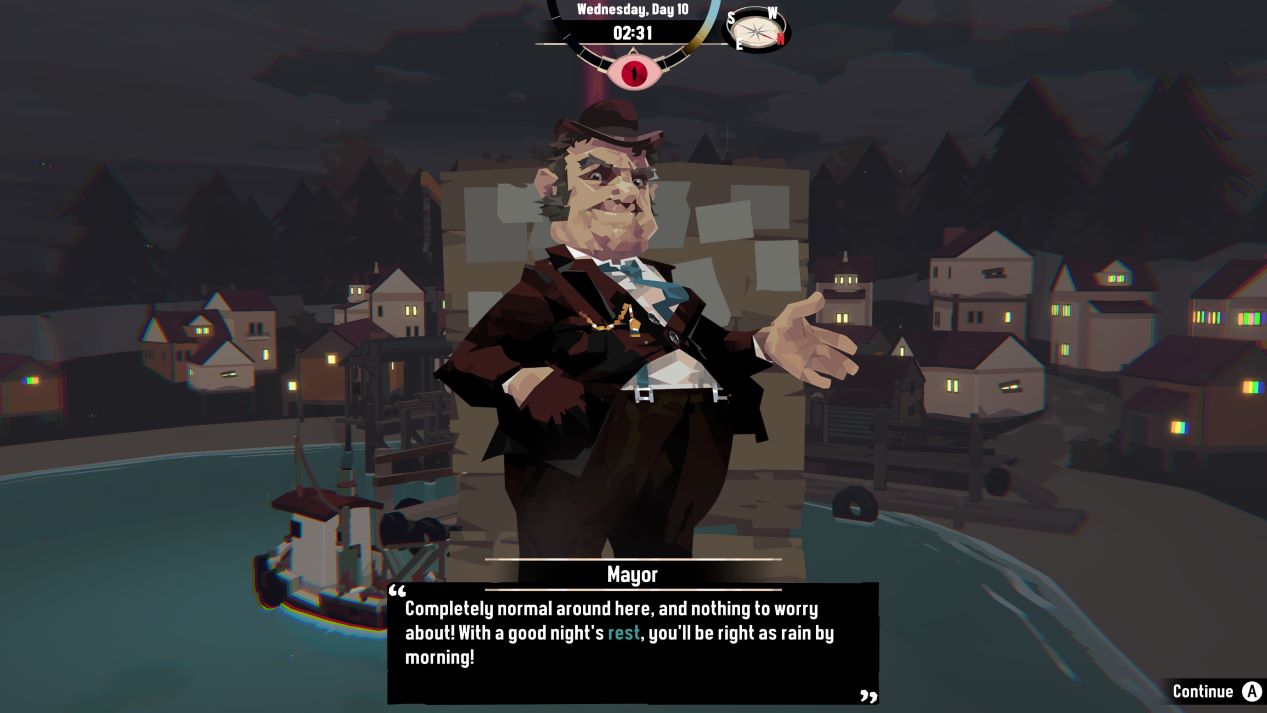
Background is a fishing village, many of the houses have lights on. There is a fishing boat sitting at the dock to the left of the image.
Superimposed over the top, is a middle-aged white man wearing a black top hat, suit jacket and trousers. He has a white shirt and a blue tie.
A text box is at the bottom of the image and reads:
Mayor " Completely normal around here, and nothing to worry about! With a good night's rest (this word is highlighted in teal), you'll be right as rain by morning!"

The hold is represented by an awkwardly shaped grid which you will need to carefully arrange to fit not only the essential workings of your ship, but your catch, any sunken treasures you dredge up (hah, said the thing!), upgrade materials, as well as any other cargo you may see fit to ferry around.

The method catching of your picean prey is pretty typical of fishing minigame fare: tap a button as a dial spins around and time your presses to the highlighted areas. Do well enough and you make your catch. Hooray.

I hate fishing minigames. I have hated them in so many different game and am often grateful when the rewards of such are not mandatory for completion of the narrative. I’ll look for mods to remove them entirely, I’ll beg someone to do it for me, and I’ll just give up and write the whole thing off as personally impossible if that’s the only option..
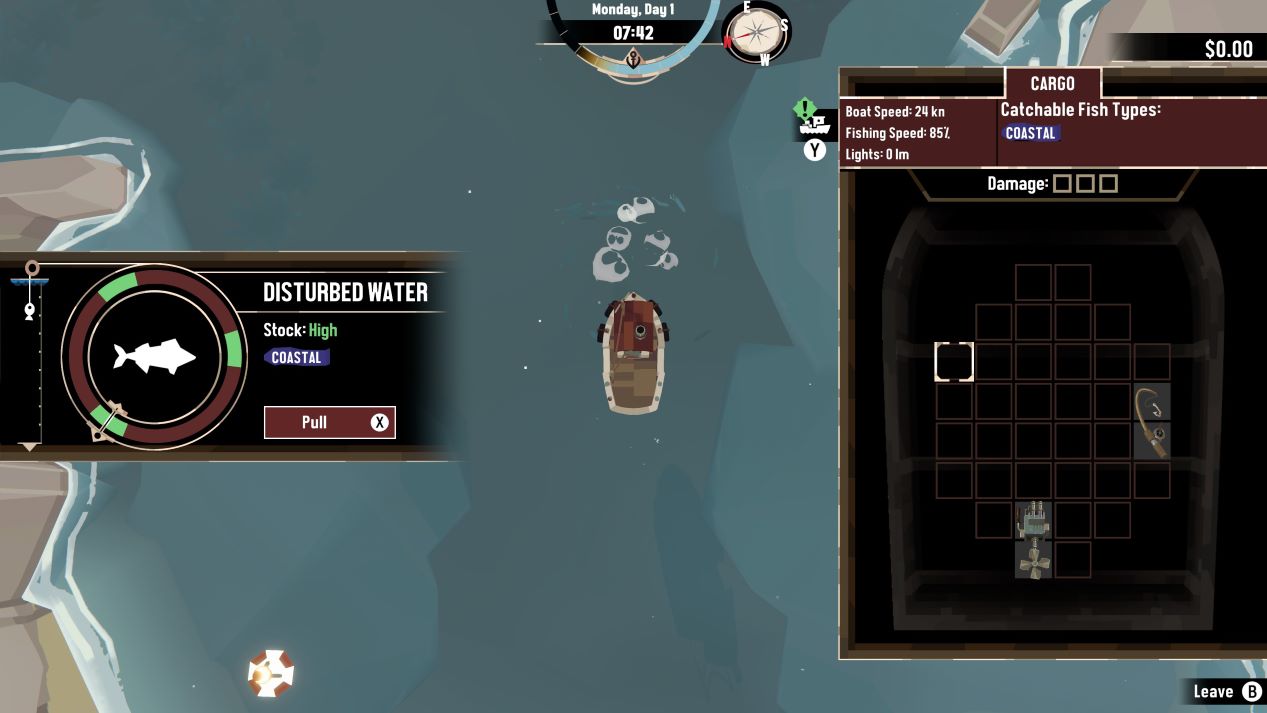
In the middle of the screen is a top- down view of a fishing boat near some disturbed water. To the left is a silhouette image of a fish which is surrounded by a thick ring. At three points around the ring are green, highlighted areas showing where the player needs to press the X button to pull up the fish. To the left of this is a simplified image of a fish on a line, showing how close to the surface it is.
To the right of the screen is a grid image of the boat itself. At the top of this display are 3 boxes for damage markers and within the grid are a fishing rod and the ship's engine.

Maybe it’s the ADHD, maybe it’s my motor function issues, maybe my brain is being interfered with by an alien ray designed to make me struggle with them as a warning from piscine beings from across the cosmos to leave their distant, digital kin in peace.

With that in mind, you may wonder why I would bother even picking up a game where the whole concept is 8-12 hours of fishing minigames tied together with a cosmic horror mystery, ill-fated lovers, and an occasional squelching package delivery service plot.

If you answered “cosmic horror mystery”. You get a (probably not cursed) gold star I found in a shipwreck, one stormy night, just as the fog rolled in and the reaching, shimmering, crimson lights attempted to take me in their haunted embrace from out the dark. While the fish in my hold seemed suddenly to be carrying more than a strong odour and damp regret at the decisions which brought them to this assured end.

Also, it was pointed out to me that there are accessibility settings to make the fishing more manageable. From the options menu on the title screen (or at any time during play on the pause screen), you can go into the accessibility settings and turn on a “relaxed fishing mode”. If you don’t press anything, the fish will be very slowly reeled in. If you take a stab at the quick time event anyway and press at the correct time, you’ll put a big dent in the distance between your prey and your reel. Meanwhile failed attempts will stop you dead for a few seconds. And that… could get dangerous.
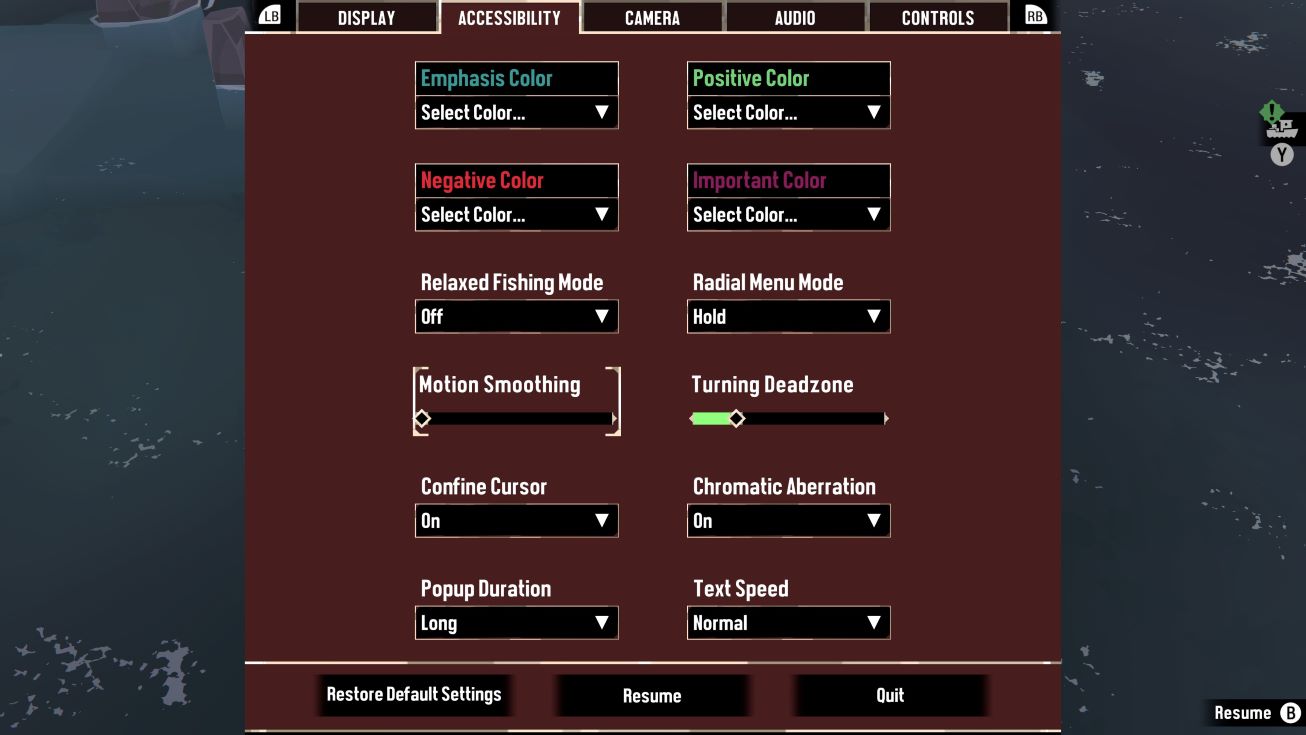
Image shows a dark red menu screen. There are options for Emphasis Colour, Positive Colour, Negative colour, Important Colour, Relaxed Fishing Mode, Radial Menu Mode, Motion Smoothing, Turning Deadzone, Confine Cursor, Chromatic Aberration, Popup Duration, and Text Speed.

You see, time in this game runs on Super Hot rules. Move the boat, clock starts running. Do some fishing, tick tock. Install a new engine, that’s four hours you’ll not see again.

Day dawns at 6am and the ocean seems relatively safe for maybe the next 13 hours. As the strain of your solo sea scavenging begins to take its toll, the thick fog rolls in and cloaks the small, jagged rocks which invite you to fall and die, like the sun’s light.

With the lamps of the early game, you’ll need to move very slowly around most harbours as treacherous rocks will only be rendered at all as the weak light touches them. In fact it doesn’t matter how good your night vision is, or how well you know the area. Some rock only come out in the dark of night and will only be visible once your faint lights touch them.

Without a lot of upgrading, your hull won’t take more than a couple of hits, and if a crash is hard enough, you could be taking multiple hits at once.

Damage to your hull is marked as an unusable spot in your already limited grid. If that despicable red X is over your only rod, you won’t even get any prompts during the catching minigame, you’ll just have to wait a painfully long time to reel anything in.
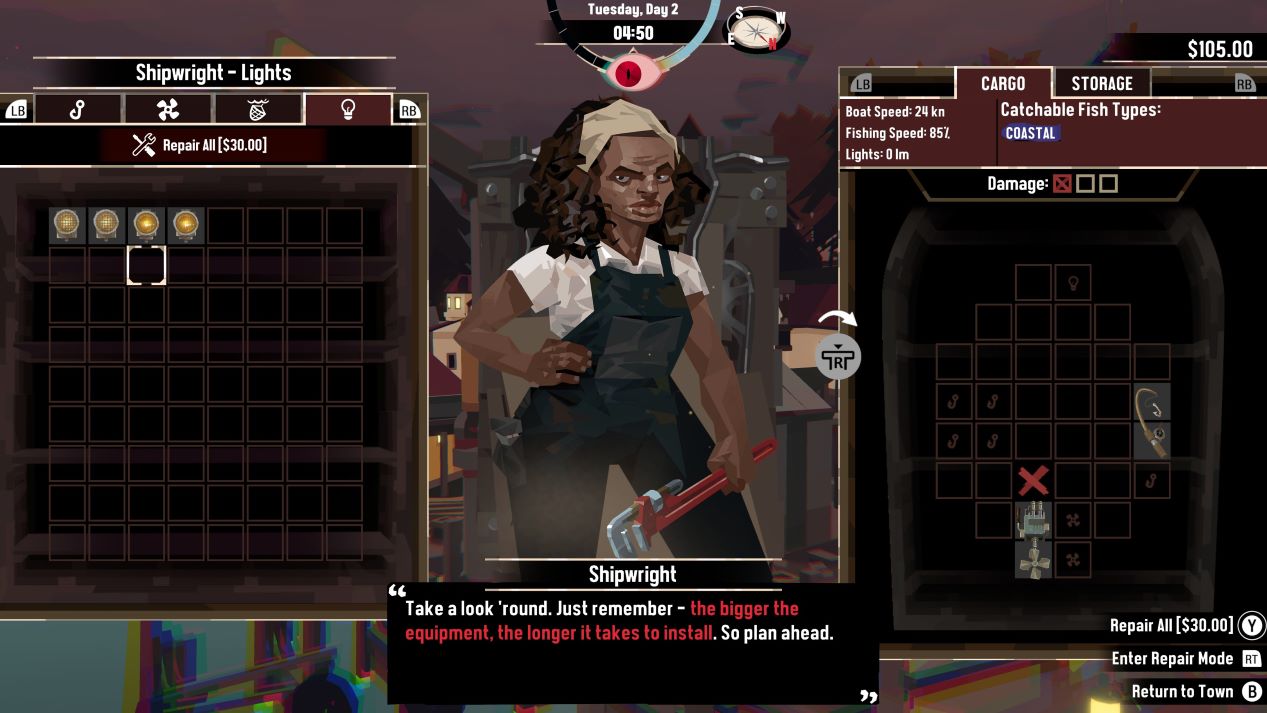
Image shows the shipwright menu. To the left is a mostly empty grid. In the top left are four lights for sale. The top of this menu shows tabs which can be moved to using LB & RB buttons. The other tabs are marked with a fishing rod, a propeller, and a fishing net.
In the centre of the image is the shipwright. She is a black woman, maybe 20-30 years old, wearing black dungarees and a white, short sleeve shirt, and holding an adjustable wrench. Her shoulder length, black hair is held back by a white scarf.
On the right is a similar menu to the left side, showing tabs for Cargo, and Storage. Beneath this are the damage markers, the first of which is filled in. Below is the oval shaped grid which shows a fishing rod, engine and a red x to show where the damage is within the ship.
At the bottom of the screen is a text box which reads:
Shipwright 
"Take a look 'round. Just remember - the bigger the equipment, the longer it takes to install (this part is highlighted in red). So plan ahead."

If it’s on one of your engines, you could be stuck limping along at low speed on one engine, and just maybe, further out to sea that you might be able to safely make it to port before sunset.

Perhaps worst of all, if you had a precious treasure or even a fish in the spot where the breach occurred, that item is gone for good.

This fragility inspires careful rudder work and a weather eye on the all to swiftly passing hours. Even so, a very reasonable fear of what moves in the dark will not avail you when the fishmonger presses you to seek more elusive prey for his special orders. There are some deep sea dwellers, which only can only be sought under the pale light of the moon.

You’re warned early on that the night is perilous, but still, the big bucks which will grant you greater freedom upon the waves, are only given to those who brave such dark waters.

An extra hour here or there isn’t so bad. Soon after midnight though, whether through exhaustion, painful solitude, or unspeakable forces beyond the comprehension of fleshy mortals, you may start to see things. Are there moving lights over there? Above or… perhaps below the water? Where are you? You were sure you were so much closer to port, but did you get turned around in the dark? Your eye (just the one, which sits beneath the clock at the top of the screen) darts wildly back and forth in panic, unsure of what is reel and what is or imagined.

I won’t spoil it, but things get weird out there and I do not recommend it if you value your vessel or your life.

Along your journey, you’ll catch many different types of fish, each will be catalogued in your encyclopaedia. Incomplete entries will tell you in which regions to search, what manner of equipment is required, and even the time of day they can be found. If you’re a completionist, there’s a satisfying amount of sea-life to seek. Including rare and exotic specimens and even the twisted aberrations.

Image shows same fishing UI as mentioned above for catching fish. However, this time the silhouette on the left is not a fish, but a sparkling ring. Instead of a single ring around the item, there are two concentric rings which have small black chunks taken out at uneven intervals. A small white arrow at the top of the outer ring shows the current position of the cursor.
To the right of the screen shows the ship's cargo hold. It contains many fish as well as two engines now and a two different types of fishing rod. In the centre of the hold is a fish which is highlighted in dark pink. I has yellow scales and 5 black eyes.

Speaking of which. Every now and then you’ll be fishing a well stocked spot, pulling up minnow after minnow. It’s not until one comes up with a few too many eyes; pulsating, bulbous protuberances; or teeth where they’ve no right to be, that you start to gain an understanding of the sickness beneath these waves.

Each entry in your encyclopaedia has a corresponding aberration or three. While these will fetch a greater price from the fishmonger, they may also have uses in other ways (which you’ll have to find out for yourself).
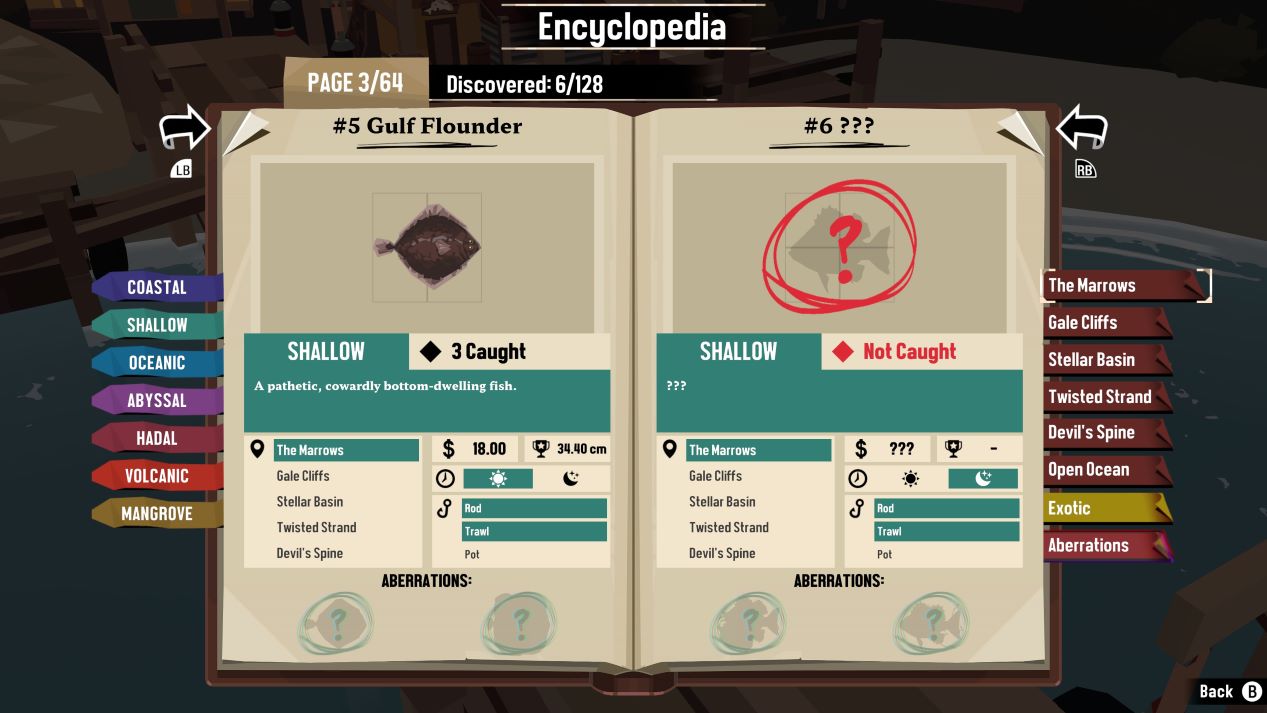
An open book shows a large flat fish on the left page, which is marked as "'#5 Gulf Founder"
Below the image is the type of water it can be found in (shallow), the number caught, a description "a pathetic, cowardly bottom-dwelling fish."
Below this is a section highlighting the area and time of day it can be found, the type of rod/net/pot needed to catch it, the average sell price, and the largest recorded catch. Below this is an area marked "aberrations:" and two greyed out areas, each with a ?
The right hand page shows a mostly empty entry as this fish is not caught. It still shows when, where, and how this fish may be caught.

Along your journey you’ll find various books to read. From your onboard bookshelf you can select an unread edition which your character slowly works through as you go about the usual business of travelling and fishing. Each volume unlocks a bonus for things like fish stock depletion, better deals in shops, and increased movement speed.

Most books are given as rewards for completing missions for folk you meet along the way, so it’s worth checking your quest log (here labelled as “pursuits”) to see if that belt buckle you just found is someone’s long lost memento before you try to sell it off to the trader for a few bucks.

It’s all well and good that your character gets some reading time in, but if you, the player, want some stories of your own, you’re not restricted to the peculiar denizens of the islands and/or fellow folk who float along who you pass along the way. Throughout the world a number of messages in bottles can be found bobbing in the brine. Each combining into a potentially missable mystery of their own. In fact, in my playthrough I had seen one of the game’s two endings before finding the final piece of this tale.

Image shows the sun rising above the treeline of a small island ahead of the fishing boat. The island has many fir trees and a small harbour village. The sky is warm and orange, while the sea in the foreground is dark and blue.

The art in Dredge is very reminiscent of games like Dishonoured or Disco Elysium characters are painted with thick brush strokes, and often in a cold and bleak colour palette, with somewhat exaggerated features. The world at large is often similarly stormy, and the weather seems to worsen as you progress through the narrative. That said, the sun rises are quite beautiful, and clearer days do much to lift the mood upon the wide ocean.

When the world grows darker, and in such areas which lie permanently swaddled in gloom, you may catch sight of the beauty beneath the tides. Gently waving sea weeds, eerily glowing corals, and even the ominous, ruby glow of volcanic fissures which scar the ocean floor like frozen bolts lightning. This is a strangely beautiful world.

Dredge is a fascinating tale which is well told and deeply engaging, even for those of us who usually detest the mechanics of the average fishing minigame. While it may seem like a shorter experience at around 8-12 hours, the core narrative never outstayed its welcome. Once both possible endings have been experienced, I think you’ll agree that the game is exactly as long as it needs to be.

If you’re aiming for 100% completion you’ll have plenty to keep you busy for probably in the region of 30+ hours as you fill every encyclopaedia entry; complete every quest; research every rod, net, crab pot, and engine; as well as finding every hidden item scattered around the many and various islands.

The sea is calling collect. Will you accept the charges?

Dredge is available now on PC, Nintendo Switch, PS5|4, Xbox One, Xbox Series X|S

Pros:

  • Fascinating story
  • Accessible core mechanic
  • Beautiful artwork
  • Fun upgrade system

Cons:

  • Pause menu is a little cluttered

Final Score: 9/10

Shame In A Box – Anno 1800

In June of 2020 allegations of sexual misconduct and harassment emerged from Ubisoft. Since then there has been some ‘restructuring’ and some higher ups have made their departures from the company (keeping their shares in the process). However, it was reported in May of 2021, that things have not actually changed. With that in mind, there will be no final score on this review as I refuse to score anything with a Ubisoft license tied to it.

About a year ago, I heard someone give a summary of a new board game that was, at the time, only available in German. Very deep, very crunchy. A fascinating engine builder for 2-4 players, that was worth picking up and downloading the fan translated manual (everything else is just icons so no need for a reprint of the board or components). I stuck it on my wishlist until someone else pointed out that it’s fundamentally about colonialism (the plague of the board gaming world) and then it was gone.

No worries, one less thing to find shelf space for.

However, If you follow my YouTube channel, you’ll know that I get the Zatu New Release Box every month (it’s been pretty good so far). Consequently, as of this Saturday, I’m now in possession of a copy of Anno 1800.

Anno 1800 the board game is a 2-4 player engine building game that plays in about 2 hours (though your first game may take considerably longer) and is based on the Ubisoft (who I mentioned earlier, with the allegations of sexual misconduct and harassment that went on for years and who employees say have done little to change or improve on that) published game of the same name.

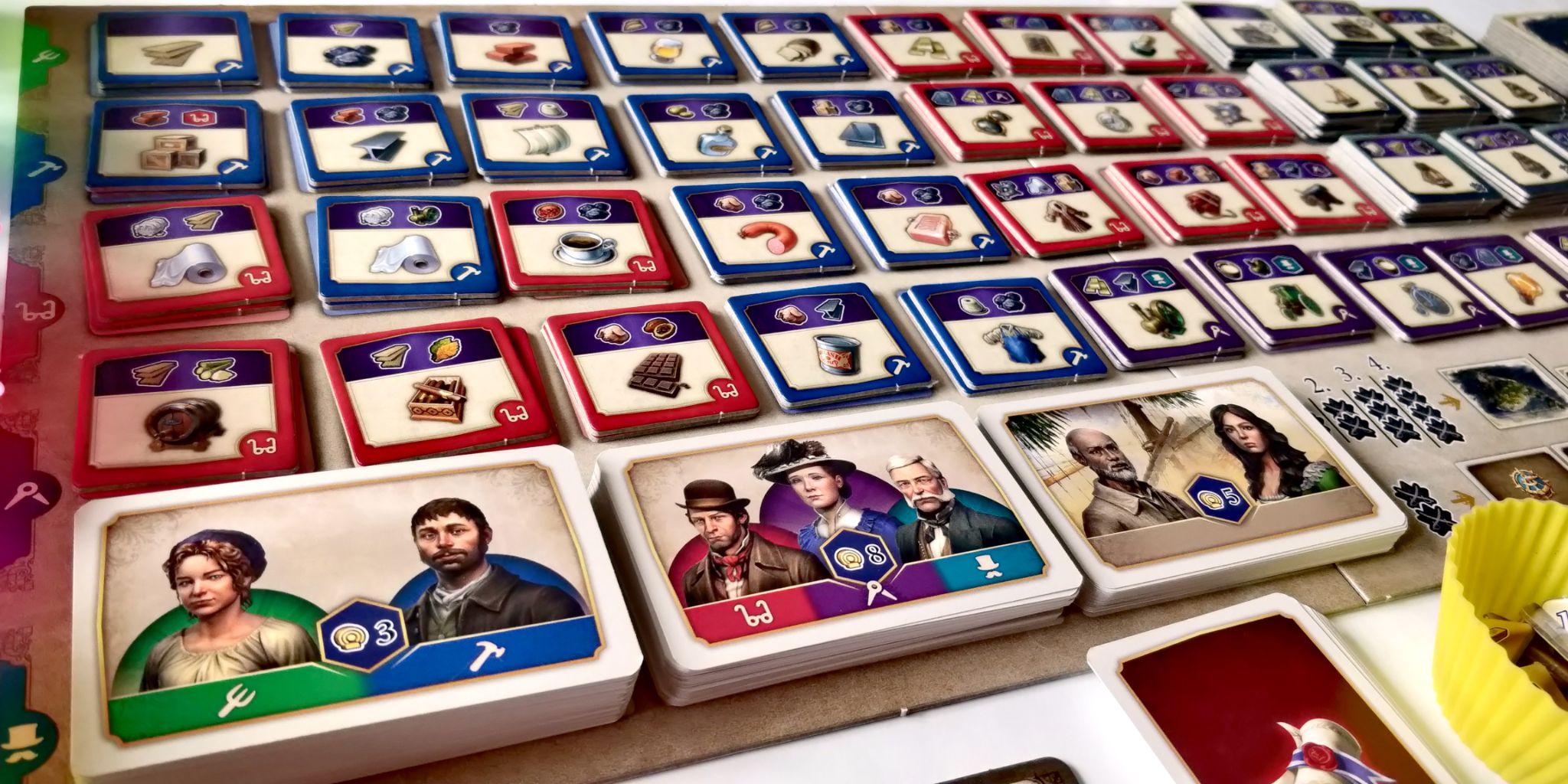
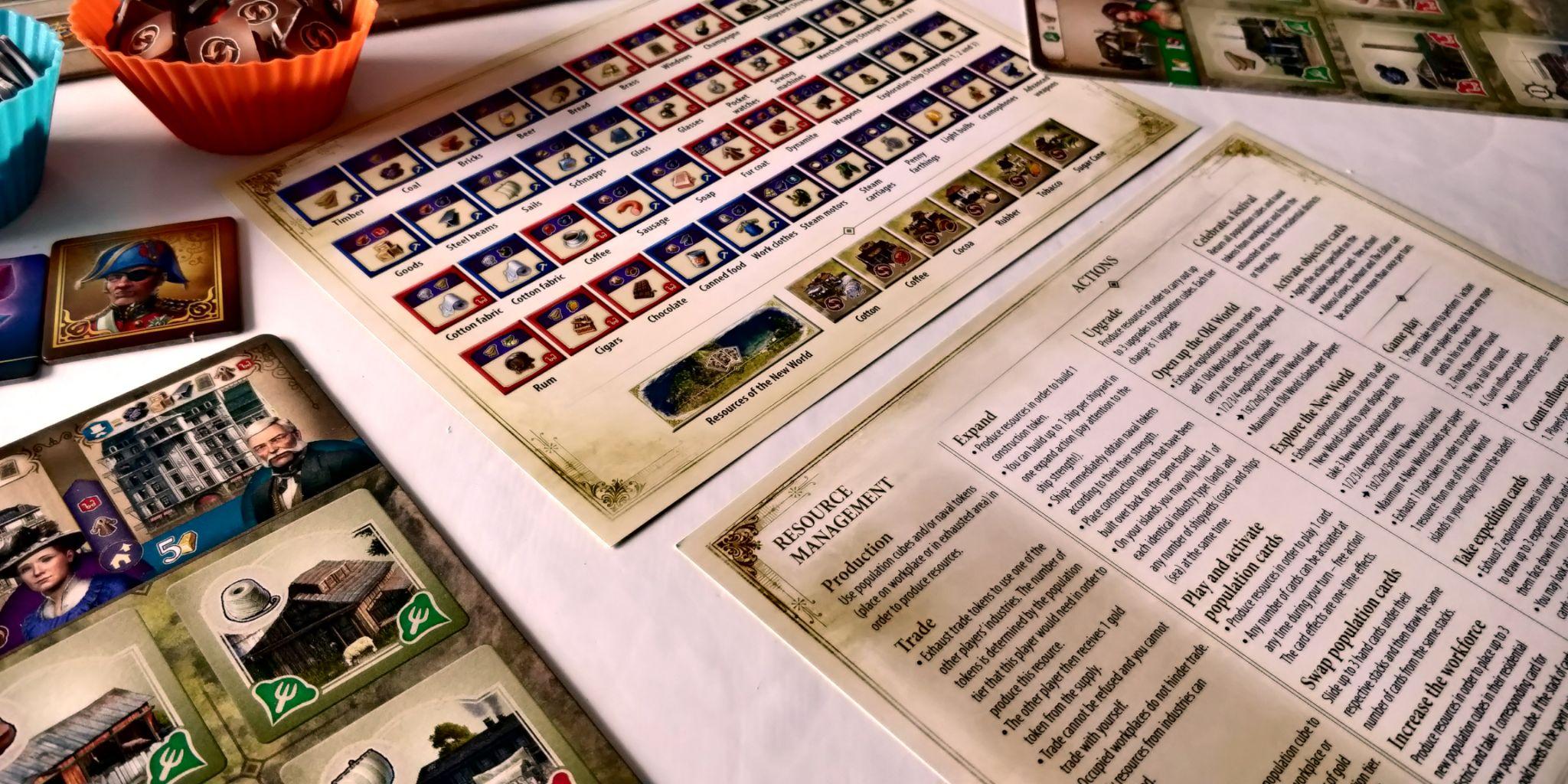
The two part game board is held together like the world’s most simple jigsaw puzzle and features spaces for the 120 construction tokens in 44 different types and four different decks of cards (three types of population and the expedition cards). Next to the board, you’ll need to create a stack of New World expansion tiles, Old World expansion tiles, trade tokens, exploration tokens, gold, and population cubes (divided into five colours). Players then get a home island board each, a starting population (cubes and their matching cards), a couple of trade tokens, and a game aid. All in, you could be looking at 10 minutes set up, especially the first time, as those construction tiles require a lot of sorting.

The game largely consists of picking a construction tile you want to build on your home island, placing workers on spaces on your board in order to generate the required resources (or trading with other players if they have a resource you don’t have access to) and placing the construction somewhere on your board to make it available for generating a new resource in future.

In addition, players can expand their workforce in the same manner, allowing them to do more before they run out of available workers, open up more of their home island to construction, explore the New World (potentially giving access to otherwise unavailable resources like sugar cane, tobacco, rubber, cocoa, cotton, and coffee) complete population cards (to earn victory points), or celebrate a festival (making workers and sea vessels available to use again).

The game ends when any player has no more cards in their hand. That said, it can be very difficult to tell if ending the game is the best idea for you since victory points are mostly based on what population cards you’ve completed. With Farmer/Worker cards being worth 3 for each completed card, Artisan/Engineer/Investor cards are worth 8, and New World cards worth 5 each.

Lastly, there’s points based on expeditions and objectives. 5 objective cards are randomly laid out at the beginning of the game, these will either allow once per turn bonuses, or end game bonuses based on things like who has the highest numbers of engineers or how many New World tiles a player has taken. Expedition cards are a bit different, these show an animal on the left, and an artifact on the right. Each is on a coloured background, which defines which type of population cube you will have to assign to it during scoring in order to gain points. There are a couple of objective cards, the zoo and museum, which will give you points for each covered animal and artifact respectively.

I’ve simplified as much as possible because otherwise we’ll be here all day on rules explanation. So moving on.

“I’m making a cool game based on a tech tree, lots of things that require other things, a little peaceful Euro game style interaction with other players, gathering of resources, interlocking systems?”

Cool idea, tell me about the setting.

“Well, it’s called Anno 1800, so we’re giving the vibe of the industrial age.“

Machines, cool. Go on.

“There’s also some colonial era trade stuff.”

Yikes.

“Not to worry, we’re going to obfuscate it by naming your home island as the Old World and other places the New World. We’re also keeping the art on the board and New World tiles completely free of people, that way people don’t have to think about the exploitation.”

*silently blinking in a shocked manner*

“Most of the New World cards will feature people of colour, in fact, there’s only two white people in this whole deck (one who looks like a british explorer and the other is a missionary nun). Oh, and to get to explore the New World you’ll need exploration tokens.”

Uh-huh, and so that token would be represented by, like, a compass or a ship or something?

“Nah, it’s crossed swords.”

*sounds of screaming followed by sending this person to learn some fucking history and how not to be gross*

Look, I agree, there’s something majestic about a big ole ship sailing the ocean, there’s a magic to exploring the world in which you live (personally I love finding a bit of woodland I’ve never walked through before). There’s fun to be had in solving the puzzle of a tech tree.

However, white European history is full of atrocities carried out on people from other parts of the world. You can’t just make a fun game about the exploitation of indigenous people and resources and try and smooth off the edges by not directly tying people to their land and hoping we don’t notice.

If you want the basic concepts of this type of game to work, you probably need to set it in space and make it about establishing mutually beneficial, non-exploitative trade with the indigenous peoples you encounter (although, too often when someone tries this, they love getting stuck in with a slave race or something from one of the planets they visit).

Okay, last points, let’s wrap up.

The cards are super flimsy (think Terraforming Mars levels of thin), the game aid sheets are printed on glossy paper and feel super fragile, if you’re someone with obsessive issues, you will spend much of the game straightening the tiles on the game board as they will get knocked all the time.

Pros:

Cons:

  • Ubisoft license means you’re giving money to a company who are rife with allegations of sexual misconduct and harassment, who have done seemingly nothing of any real consequence to atone for this or help those who were victims
  • Components are flimsy
  • Chock full of colonialism, with the corners rounded off

Final Score: Don’t Fund Ubisoft/10

Postcode Lottery – Monopoly Bid

Monopoly sucks. It’s not a controversial opinion. It takes too long and despite its origins, it glorifies property hoarding. Why it sells as well as it does, even to this day, I have zero clue.

In answer to the length issue, Hasbro offers you Monopoly Bid. A 2-5 player card game that can be played in as little as 5 minutes (I’ve seen it claimed this takes 15-20 minutes, but I knocked out my first three games in that time, and that includes reading the manual).

Set up is as simple as dividing the blue backed property cards and red backed money cards, shuffling both decks and dealing five of the money cards to each player. Money comes in denominations of 1-5, but amongst these cards are four types of action cards: Wild cards complete sets of properties, Draw 2 cards allow you to draw more cards from the money deck, Steal! allows you to steal a property from an opponent’s incomplete set, and Nope! cards are used to cancel any action cards (including other Nope! cards).

On your turn, you will host an auction (youngest hosts first). Everyone draws a card from the money deck, the host flips over the top property and then plays as many action cards as they wish (with opponents using Nope!s if they wish to prolong the agony), and finally everyone starts to bid for the property. Players secretly select the amount they’re willing to pay and reveal on the count of three. If there’s a tie, the tied players may keep bidding. The winning bidder puts their money in a discard pile and places their new property in front of them, everyone else keeps their cash, and play moves to the next round. If no one bids, the card goes to the bottom of the property deck.

Each property set is clearly identified by colour (though I don’t know how good this would be for colourblind players) and has a number in the bottom-left corner. Until you have all the cards in a set (filled in with Wild cards or not) players are allowed to use Steal! cards to have them away from you.

Once someone gets three full sets, they are the greatest hoarder of property and win at capitalism. This is a terrible lesson to teach children.

Now, you might be thinking that there’s more than luck to this game, clearly there’s a degree of memory in the bidding, knowing what other players have shown in previous bids. Maybe, but it’s imperfect knowledge as everyone is picking up a new card before each auction. As such, it’s really all guesswork and luck of the draw on cards.

In one game I started the game with five cards worth one money each. My opponent apparently had a hand full of draw two cards and before the first auction even started, had managed to pick up half of the money deck. I didn’t win a single auction that game and couldn’t stop any cards being played as she had managed to get a fistfull of Nope!s as well. As such, I would warn everyone that this is not a game, it’s a meaningless, colourful distraction that is a complete waste of cards and ink.

I’ve posted my copy to a family member who regularly has young grandkids over, that way I’m not immediately putting it in the recycling bin. At least Uno feels somewhat substantial, get that if you must.

Pros:

  • The colour choices on the cards are vibrant
  • It’s not the Monopoly board game
  • I don’t believe it’s murdered anyone

Cons:

  • Entirely luck-based
  • Less fun than the Monopoly board game
  • Waste of resources

Final Score: 0/10

A Nice Time – Little Town

I get told fairly often that my reviews are quite negative, so let’s have a nice time and talk about something nice.

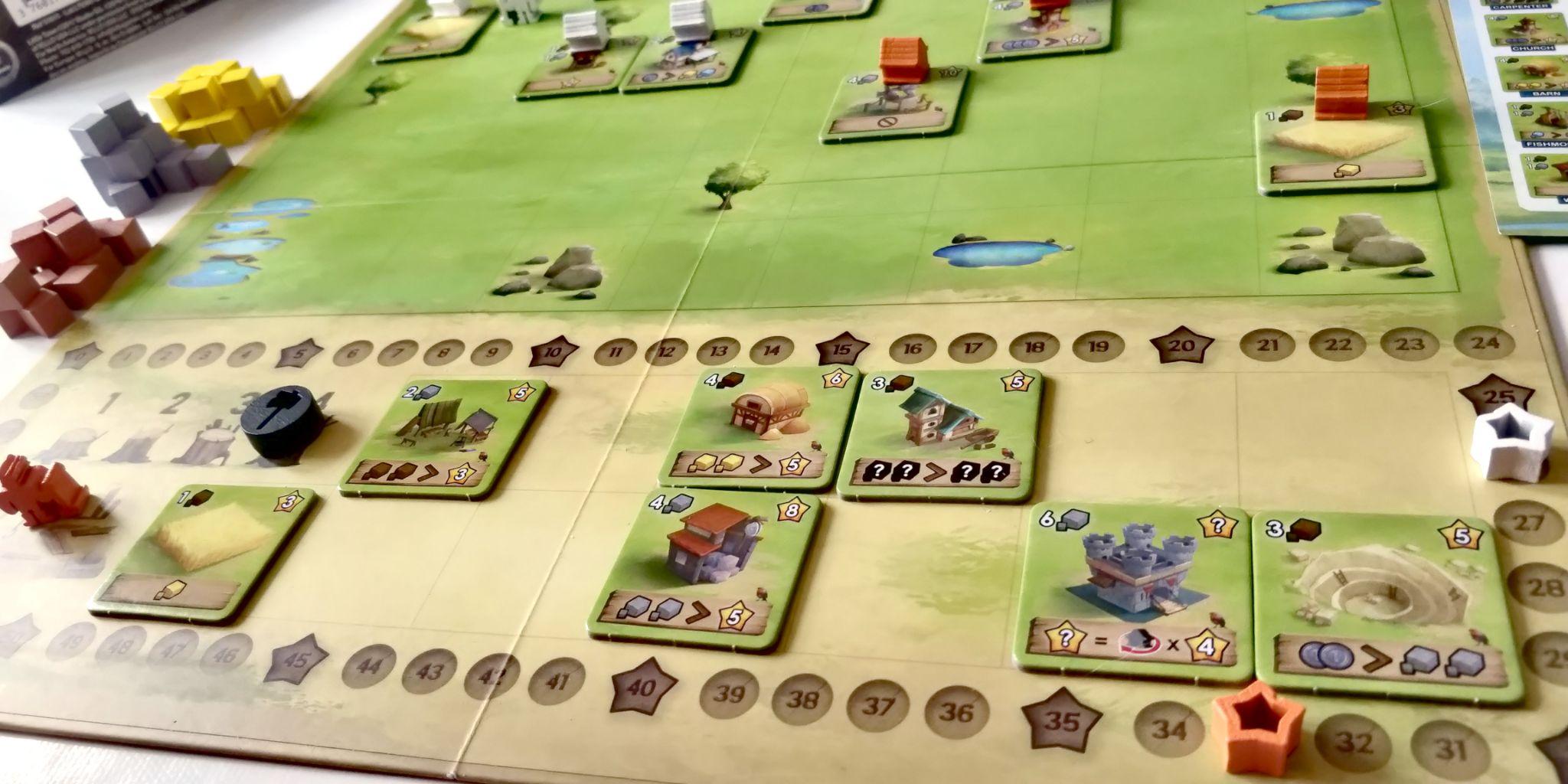
Little Town is a worker placement and tile laying game for 2-4 players and takes about 45 minutes. Players draft building tiles and lay these out along the bottom of the board (there are set tiles to help on your first playthrough) along with the five wheat field tiles, to form a shop. Depending on player count, players get 2-4 objective cards, 3-5 workers pieces, 6-7 houses, and a humble 3 coins in their pockets.

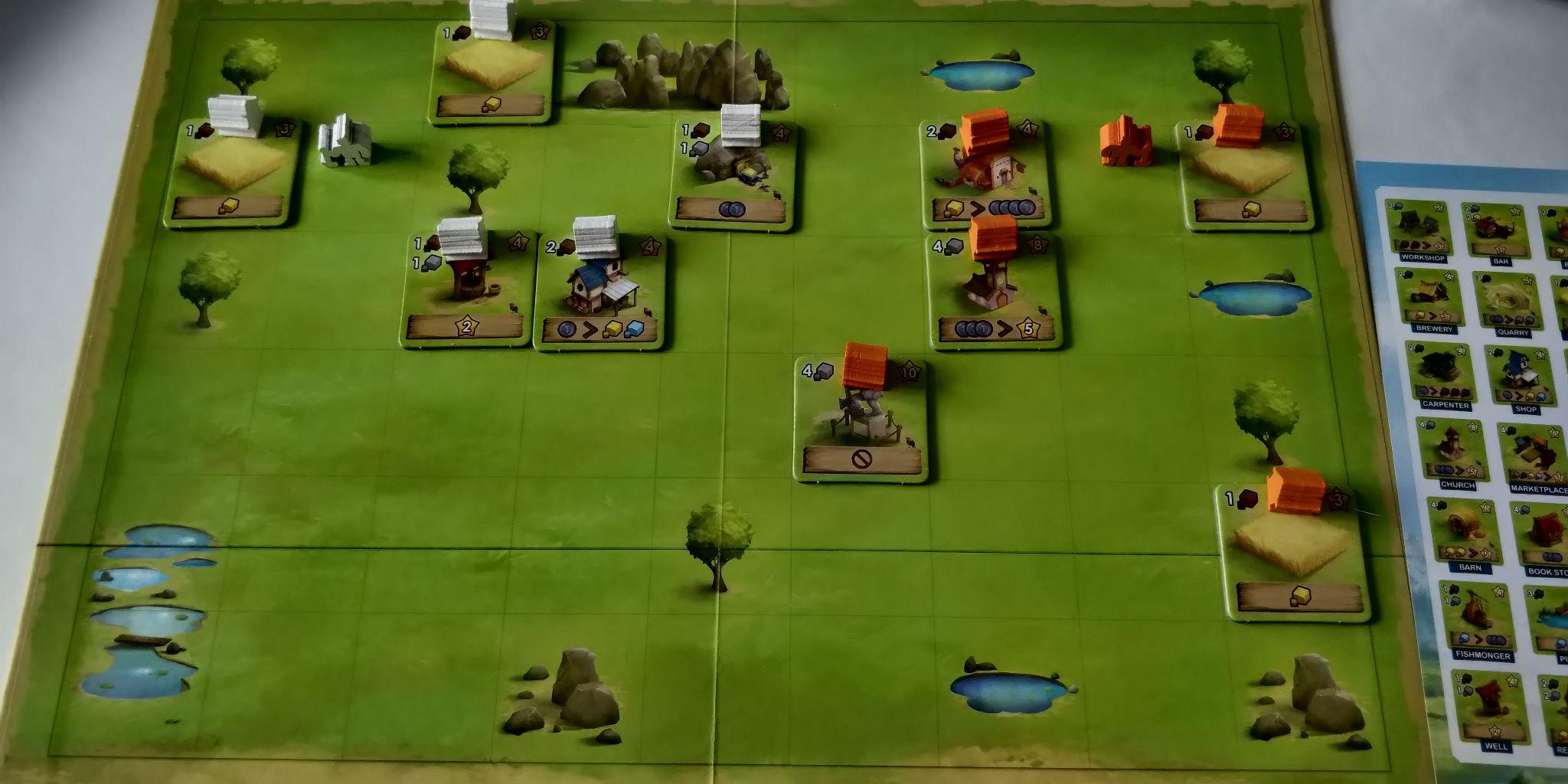
Gameplay is fairly straightforward, in a turn, players may perform one of two actions: Gather and activate, or build a building. To gather and activate, place a worker on the board and they will collect resources from all diagonally or orthogonally adjacent spaces. The board itself (which is double-sided for variety) features a number of trees, mountains and lakes. Trees give wood, mountains yield stone, and lakes can be fished for food. Meanwhile buildings that are on the board will produce resources or victory points as shown on their tile, either directly, or in some form of resource trade. However, if you wish to activate a building you didn’t build yourself, you’ll need to pay a coin to the owner to do so.

To build a building, send a worker off to the building yard at the bottom of the board, pay the cost in resources on the tile you wish to construct. Then place that tile on a blank space, along with a little house to signify that it’s one you built. Additionally, building tiles show a star value, which are immediate victory points awarded when you construct it.

Once each player has sent all their workers out, it’s time to bring them home. At which point they will need to be fed. Each worker will need one food, be that wheat (from fields that have been built) or fish. Failure to feed workers will lose you three victory points each, as they air their displeasure with your leadership.

At any time you can complete an objective card you’ve met the requirements for and claim the victory points shown. Objectives are mostly very simple: have no money, build a building that costs x amount of wood, have twice as many food resources as workers, etc. Although, that’s not to say you might not just end up never quite completing these just depending how things play out.

Finally, move the round token one space and hand the first player token to the next player clockwise and start a new day. At the end of four rounds, add together any end game bonuses from tiles, and one point for every three coins in your coffers.

Little Town is absolutely charming. You’re making a nice town together, there’s plenty for everyone to share and at lower player counts you can almost build separate areas, away from your fellow players. It might be considered a game for children by some (recommended 10+), but there’s enough strategy in the selection of buildings and when (or if) to go for objective cards, to keep adults playing too. It’s not the crunchiest, deepest, most mind bending game in the world, but it doesn’t need to be. It’s just fun, and we could all do with some fun.

Pros:

  • Easy to learn
  • Plenty of variety thanks to the tile drafting
  • Very affordable

Cons:

  • May be too light-weight for some
  • It’s a small box that could be smaller as there’s plenty of empty space
  • Unusual colour selections for player pieces.

Final Score: 8/10

I Heard A Rumor This Sucked – Umbrella Academy

In August of 2020 my Facebook targeted ads were chock full of colourful pictures of The Umbrella Academy game. As I’d just finished binging through season 2 of the Netfilx show, I’ll admit, I was interested. Something about the actual Kickstarter page failed to wow me though. As such, I was happy to let this one slide, safe in the conviction that if it turned out to be great, it would undoubtedly end up on the shelf of my local game store.

However, moments before the end of the campaign, my fiancée (a big fan of the comic books) told me she’d backed it. Hurrumble, I had no need to risk it myself, we would have a copy to play together anyway.

Now, as I didn’t back the game, I wasn’t getting the updates. I wasn’t aware that two weeks after the Kickstarter ended – after playtesters politely rinsed the designers on their shoddy cash grab – that the rules were overhauled. For that matter, I wasn’t aware of the update until after we’d played through the game twice and been utterly disappointed by its pedestrian nature.

Hang on, I got ahead of myself.

The Umbrella Academy Game is a co-operative, simple maths card game for 1-6 players, and features art from the comic book series by Gerard Way & Gabriel Bá. Players pick their preferred character from the dysfunctional superhero family, grab a life counter card, place a number of villains depending on player count, and draw a hand of cards from the hero attack deck. Once the board is set, flip the first villain over and lay out the number of villain attack cards shown.

Villain attack cards show an attack value (health), an amount of damage it deals if left unchecked, and some lovely artwork. If you’ve got the deluxe version of the game, you’ll have an entirely unnecessary board to put all these things on, with spaces that are labeled, but smaller than the cards that go on them, and not big enough to fit the number of attack cards for most villains you will encounter (which seems a weird design choice).

The hero attack cards in your hand are basically the same, but they replace the damage score with a heal value. The goal is to take turns placing cards from your hand so that your total attack beats the attack value of the villain attack. You have to fight each opponent left to right and if you get to the end of the round and haven’t beaten all of the villain’s attacks, you’ll have one chance to use your character’s unique powers. If that still doesn’t finish them off, you’ll have to divide up any damage amongst the players as you all see fit (rest assured, the first person to lose all their health and be out of the game is the real winner here).

On your turn you can choose to delay the sweet release of death, if you play a card for it’s heal value instead of it’s attack. However, bear in mind that at the end of this round, that attack is going to have to be dealt with so that heal better be worth it.

With the round over and damage divided, the villain retreats and the next one steps up. Time to draw some cards and see who’s next. Once all the villains have shown themselves and had a chance to chip away at your meager health, flip over villain deck and fight them all in one glorious boss rush round. Did I say glorious, I mean tedious and horribly unbalanced. In this final round, enemies will hit harder and need higher numbers to defeat, but gameplay is pretty much the same.

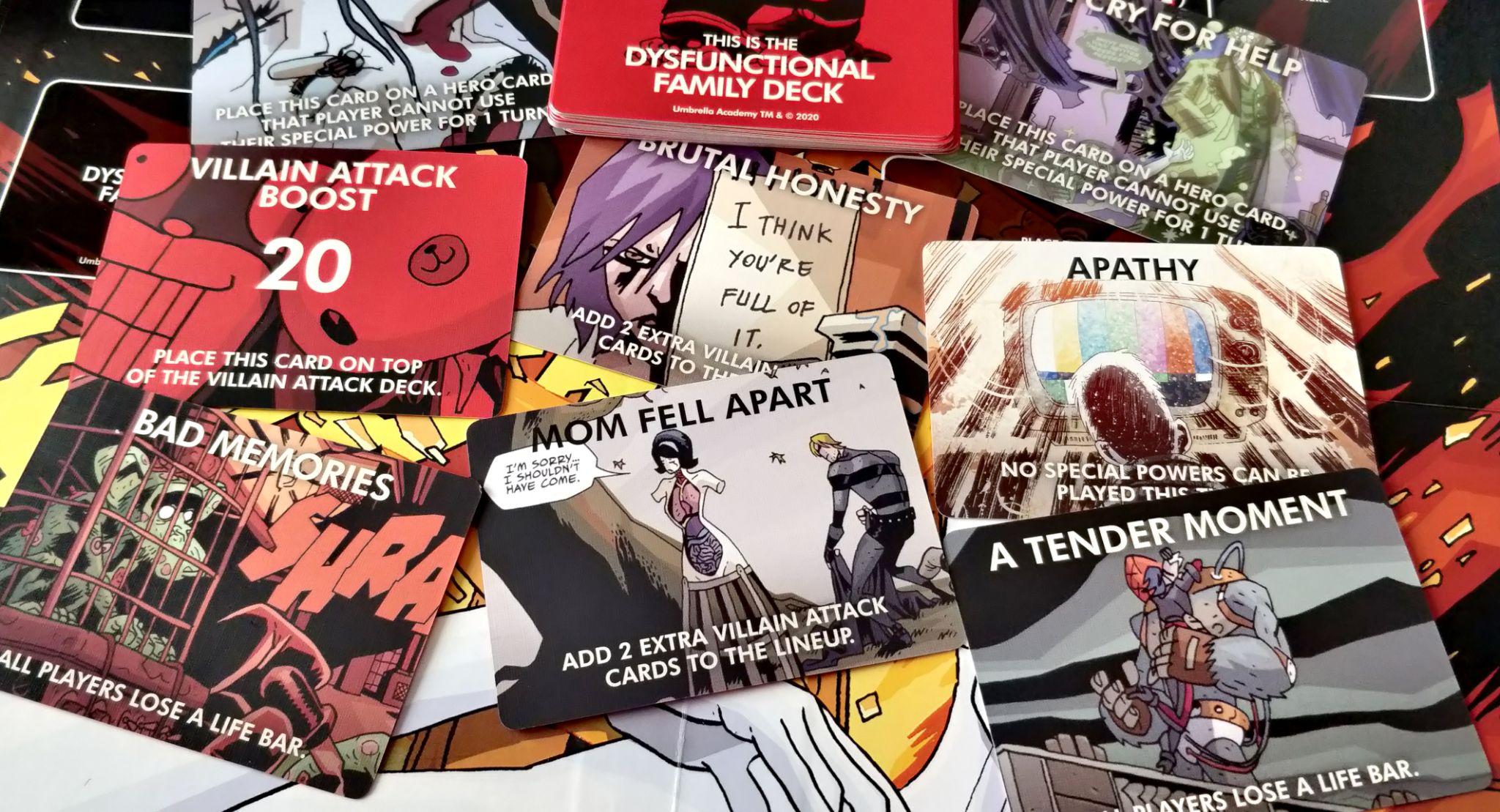
One thing I didn’t mention was dysfunctional family cards. These are flipped at the beginning of each round and attempt to add a little spice to the game. These may stop players from discussing their cards during the round, make a number bigger, or your health smaller. Many have the same effect, but with different art and card names. Either way not terribly exciting except when they end up killing a player who was just clinging on up until then.

The last thing to mention here is story cards. These are in the hero attack deck and also feature an attack value. However, rather than healing they offer bonuses such as boosting another card’s power at the cost of a life bar, restoring someone’s health to full, or letting you use your hero power twice.

Now it didn’t help that the original rule book is poorly written. It definitely didn’t help that some of the play guides you’ll find on YouTube seem to have completely misunderstood the rules, but worse than any of this: they rewrote the rules before the game was even delivered. Rather than doing the decent thing by their supporters and holding the game back while they printed new manuals and got them added to the box, or even just offering to post them out separately, they made them available as a download, which apparently a lot of people didn’t even realise.

The new rules do help balance the difficulty at different player counts and add a block function to combat (match rather than beat an attack to take half damage, but still clear the attack at the end of the round). Also rather than facing all of the villains you encountered during your game, you only face one at random and they use all the villain attack cards which you failed to overcome previously. Unfortunately this doesn’t save the game, it just makes it a little easier to swallow.

It’s incredible to me that the game was so untested that they didn’t seem to know how bland it was until two weeks after the Kickstarter campaign ended, by which time it was apparently too late to fix and had to fit within the already printed card designs. It’s a real shame as Umbrella Academy is a fascinating universe, it just wasn’t treated at all well by the designer. As it stands the greatest enjoyment I get from this game is asking my fiancée about all the different villains (my favourite is Zombie Robot Gustave Eiffel) though I think we’d both have got more enjoyment out of buying our own copies of the comic books instead of investing in this absolute travesty.

Pros:

  • Nice, clean art style
  • Starts conversations about better Umbrella Academy media.
  • Didn’t start the apocalypse

Cons:

  • Bland
  • Boring
  • Deluxe edition includes an unnecessary board that isn’t fit for purpose and 8 tokens that aren’t required for any aspect of play

Final Score: 2/10

The Tallest Tales – The Adventure Zone – Bureau of Balance

So, there’s me, Mittens the rogue, and Laurak the wizard, right. And we’re in this creepy cemetery, fighting off a swarm of rats, while having a dance-off, but it’s okay, because you know me, I’ve got this unique and distracting odor, plus I’m good with an axe. Before you know it, things have escalated beyond all sense and Mitten’s ex shows up with this arcane riddle she’s got to answer before we can get on with destroying this bone throne.

*swig*

Right, it’s your round pal. When you get back, I’ll tell you about the time we ran into this sarcastic specter while trying to win a talent show.

If you’ve ever wanted to knock out a low-seriousness fantasy roleplaying campaign in under two hours, you could do a lot worse than the rules-light role playing game in a box: The Adventure Zone – Bureau Of Balance.

Loosely based on one of a bajillionty podcasts by the McElroy Brothers. It’s designed for 2-5 people and takes 60-90 minutes to dungeon crawl through. There’s no maps, no hefty tomes full of rules, only one type of die, and very little maths. Setup is pretty simple, players take a character sheet based on class (warrior, rogue, wizard, bard, or priest) and answer a few questions about that character (there’s prompts on the back of the sheet to either steal from or just get ideas about who your character is). There’s also space to name their adventurer and even draw a mugshot for posterity.

That’s it! No rolling stats, no picking up gear, no deciding on which pack is best for your adventure. All the numbers come printed on your sheet and they never change. Warriors are good against monsters. Wizards are good against magical challenges. The point of this game is not to worry about numbers so much as to tell a fun story together.

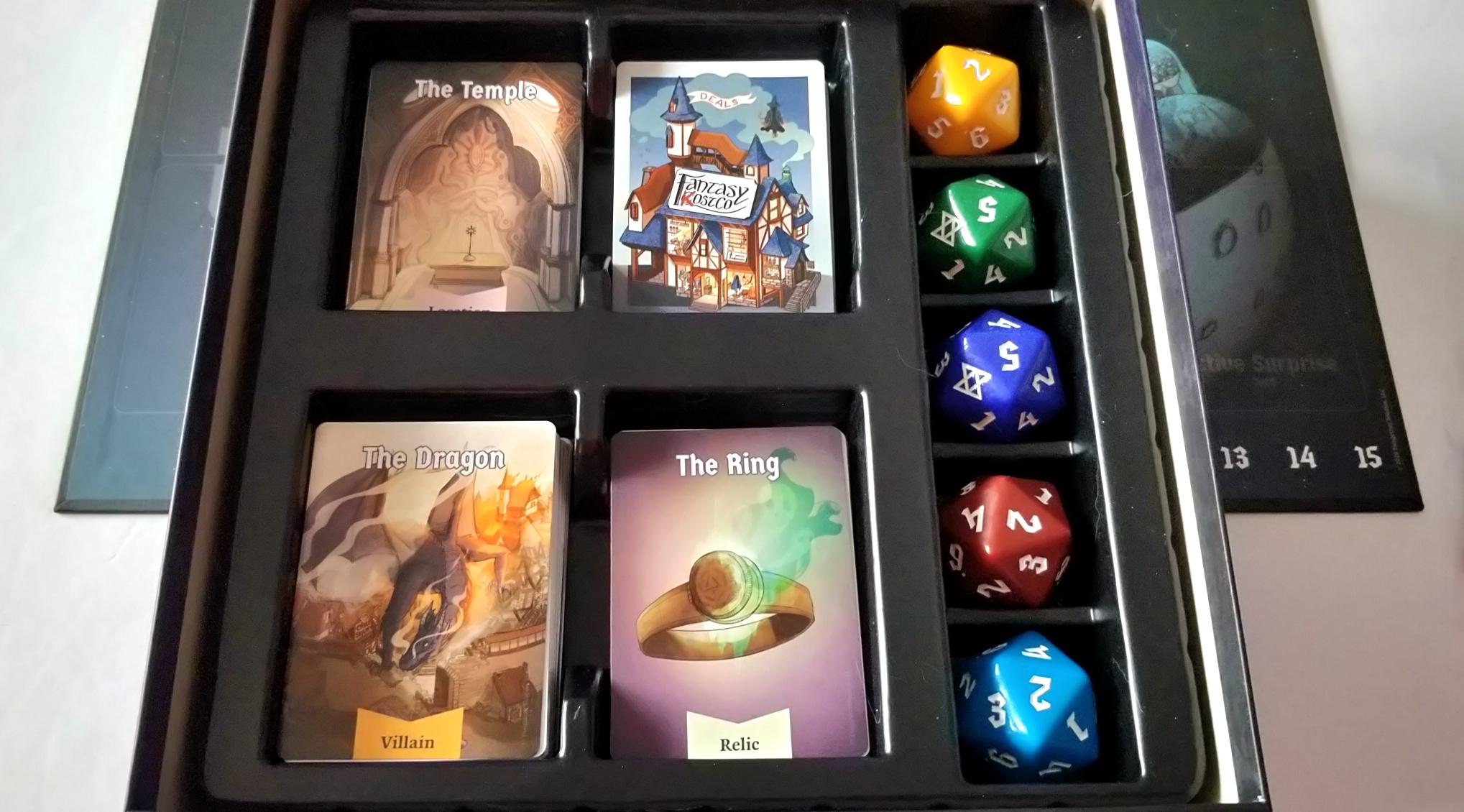
Now, to the adventure itself. Forgoing the common use of a Game/Dungeon Master player typical of most role playing games (thought there is a team leader who is in charge of gently nudging play forward), BoB sees this role taken by small Challenge Decks. One to represent a villain and their minions, the next a relic of power, and finally a location for it all to take place. The game includes a number of each so you could be after the Lich who wants the Ring and hangs out in the Tomb, or the Cult after an Idol on a Train. All of the decks are playable with each other meaning you can get an awful lot of replayability out of this box. Besides, playing with different groups, who knows how they’ll interpret the story in their own way.

Each deck includes 10 cards, each with a scenario and a few numbers. There’s a big number at the top of the card, this represents the score the players need to beat that round. To the left and right, there may be an arrow, which includes a modifier number for the card in that direction. For example, Reliving Your Biggest Mistake, includes +1 to the left, this could make the Swarm of Crawling Hands (usually only a 7) up to a difficulty of 8 (as I said, it’s very simple stuff).

Below the numbers are the card’s name, and below that there may be symbols, denoting the type of encounter this is (monster, spooky, magic, etc). Next is an all purpose box for prompts, and special rules. Some will include effects that remain as long as the card is on the board, others will grant bonuses if you can explain some story aspect of the card (what does something look/smell/taste/sound like?) during your encounter with it. At the very bottom, there’s a skull with a number, showing how much damage it will do if you fail your encounter, and another showing the value of treasure you get for defeating it.

Which brings us to Fantasy CKostCo (it’s legally distinct for the board game) cards. If you’ve earned three loot, you can grab yourself an item card from the deck. It could be Railsplitter, an axe that gives you an ongoing bonus against monsters and a bonus when you help a friend fight a monster; or some very adorable Slippies of Haste, which give you a bonus against monsters and traps. If you’ve got the deluxe edition of the game, you’ll get an adorable slot-together model of the Fantasy KostCo to hold your cards, but it doesn’t seem to stay together very well (at least ours doesn’t) and you’ll regularly end up with cards flying everywhere (save yourself $20 and get the standard edition).

You’re not allowed to hold more than two item cards, but there’s a really nice mechanic, whereby if you earn enough to get a third item, you can immediately give one to someone else on your team, meaning that even if one player hasn’t managed to get any loot themselves, they won’t be underprepared as you move on through your adventures.

If you’re playing more than two players, the last thing you’ll need to do is add a surprise card to each Challenge Deck, to be uncovered once you’ve got past the first four cards. These surprises are helpful friends who will aid you in your quest. They even get their own little space on the board to hang out in, until the next surprise comes along to take over.
So, the board is set, the quest is planned(ish) and the party introduce themselves (and show off their stick figure art of a wizard gnome), time for adventure. On a turn, players chose one of the three challenges to take on, work out how much strength they have (based on the numbers on their sheet, plus any bonuses from items or surprises), tell the story of how they’re going about this quest, ask for assistance from another player (if they don’t think they can beat the challenge alone), and finally roll their dice.

I forgot to mention the dice in this game. They’re big enough to concuss someone if you are the type to throw things when you fail a roll (please don’t, and maybe get some help for your anger issues). While they look like standard twenty-sided dice, they actually only feature the numbers 1-6 (three times each), as well as a big X for an epic failure, and a Bureau of Balance symbol for a critical success.

Anyway… roll the die, add it to your total strength (including any modifiers for items or help from your party) and if it’s higher than the challenge rating, you win and you get that card.

The story ends once two of the challenge decks are exhausted.

If you’ve got people who are really able to go with the flow and can whip up some silly detail about their challenge, you can get some really fun group storytelling. Even if you’ve got one fairly quiet player, you can still get a fun story together, thanks to the cards themselves and the way the game wants you to interact with it. I’ve had some fairly difficult games with this box (and more than a few adventures that got really horny), but never one that didn’t get at least a few good belly laughs.

The Adventure Zone – Bureau of Balance probably isn’t for hardcore Pathfinder or D&D players, but if you’re looking to experience a rules-light, no-DM, co-operative story you can play in an evening with no prep, you could do a lot worse than this. Perhaps a good introduction for getting friends into the world of role playing, without scaring them away by making them read a 300 page player manual first.

Pros:

  • Easy to pick up
  • Nice artwork
  • Lots of fun

Cons:

  • Can experience difficulty spikes
  • Not very deep
  • Deluxe edition feels unnecessary

Final Score: 6/10

Going For Goldberg – Steampunk Rally Fusion

In 2015 teams of inventors first donned goggles and took up their welding torches in card-drafting, dice-rolling race game, for 2 – 8 players, Steampunk Rally. Then Orin Bishop looked upon this complicated box of delights and cried “more!” And so, in early 2020 a Kickstarter launched for Steampunk Rally Fusion.

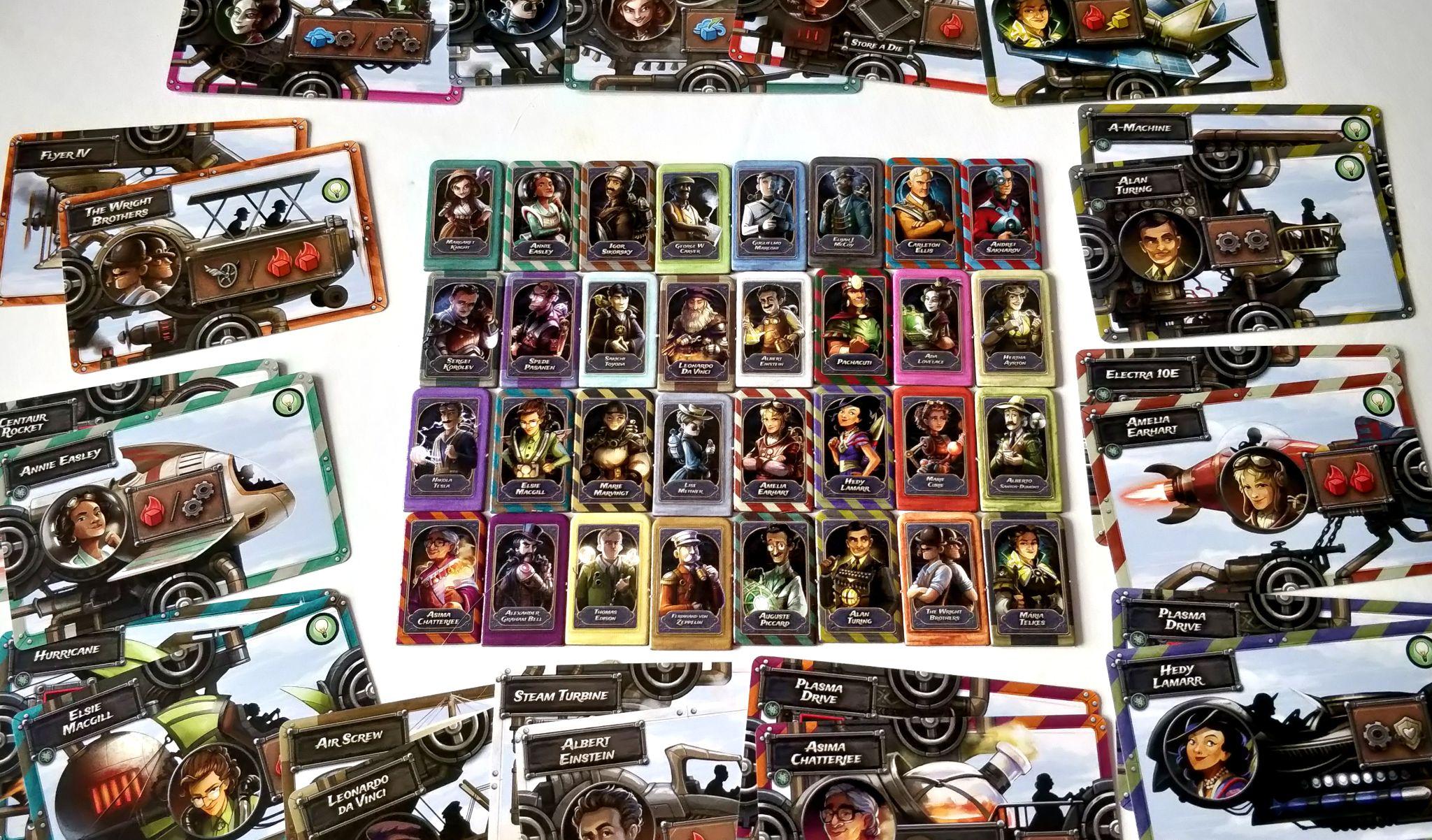
SRF takes all the gameplay of the original and adds new courses, new types of dice, new inventors, new vehicle parts, new boosts, event decks, crowd challenges, and a solo mode. Due to how I backed, this review covers Steampunk Rally Fusion – Atomic Edition, which neatly puts both versions of the game in the same box for an absolutely huge experience.

Initially the contents can be a little overwhelming. There’s gold silver and bronze parts, as well as boosts for both editions, a staggering number of inventors, and enough dice to square up to a copy of Chip Theory Games’ Too Many Bones (including the new fusion dice which are beautiful 2 colour d6 numbered 4-9). However, once you’ve got through your first few turns, it will all come clear.
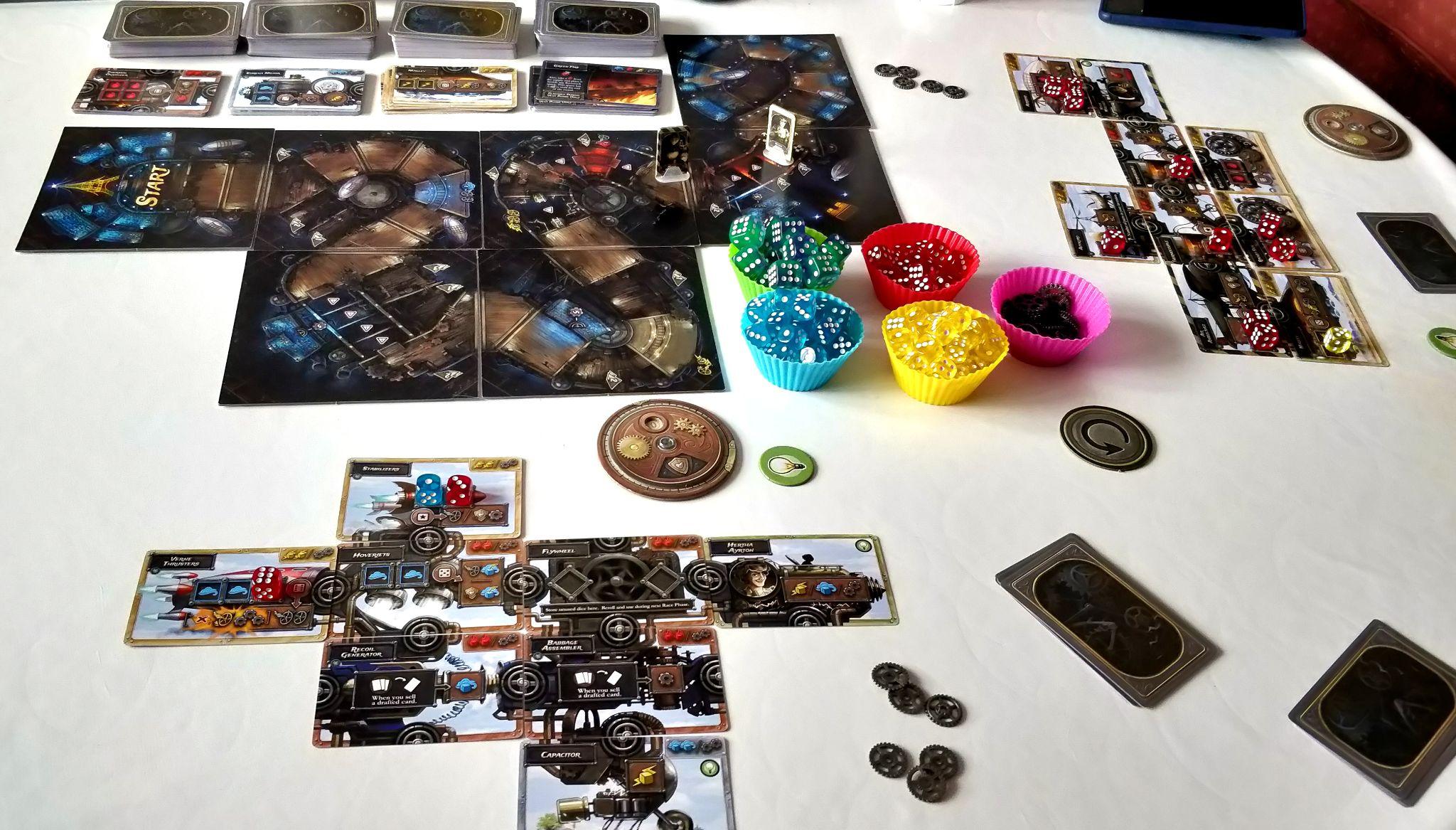
The aim of the game is to race along a modular track and make it as far over the finish line as possible. Along the way you will be adding various parts to your vehicle to propel you onward, damage your opponents, or generate resources to help you do that other stuff.

Players start by picking an inventor and taking their associated starting vehicle part. They then arrange them so that valve symbols on each card are matched up. All parts that are attached to these wild machines must include an unbroken line of valves going back to the cockpit. Luckily you can rearrange these mechanical monstrosities on the fly (or roll, or hover).
Each round sees players draw a card from each of the three parts decks and one from the boost deck. They then take a card and pass their hand on to the next player. Bronze parts have valves one all four sides so are mostly about expansion; silver parts help you gain and multiply dice, as well as converting dice to different types; finally the gold parts are mostly about movement. It is a race after all.

When drafting cards, players can either attach them to their craft or sell them off to gain dice or cogs. Meanwhile boost cards can also be sold or kept secret, to be used later for benefits such as extra cogs or damage to opponents.

With the draft down players can get moving (there’s another phase but I’ll come back to that). Time to roll all those dice you’ve generated and start placing them around your vehicle to get moving, raise shields, or make attacks. Here cogs can be spent to either raise the value of a die by one or reroll it.

Most machine parts will give you some reward based on the value of the die or dice you add. For example, inserting blue dice with a total value of 15 into a part which grants one forward motion for every five points will grant you three movement.

Some things to consider though. There are some areas of terrain that will damage you if you’re unable to raise enough shielding or move smoothly. For each point of damage you fail to defend against during the race phase, you’ll have to remove a part of your machine. If your final part explodes, you’ll be sent to the space behind the player in last place and have to start your vehicle from scratch.

With the race phase over and damage done it’s time to wipe down your engine (ooh-er) and get ready for the next round. All unused dice are put back in the supply and damage counters are reset. However all spent dice stay in place. Sadly this means you’re going to have to find a way to clear them out if you want to use that part again. This is where the vent phase comes in.

Following the drafting phase, players can spend a cog to remove two pips of value from any die (or split the points across two dice). Once they reach 0 it can be removed and the slot can be freed up to use again.

Eventually someone will cross the finish line. However, this isn’t about who finished first, it’s who got furthest over. As such a final round is played out and whoever is furthest over the line at the end of that round is crowned the winner. Although it’s probably like golden goggles instead of an actual crown, because, you know, steampunk.

Well, that’s it, race over, nothing more to see.

But wait, there’s still more stuff in this dang box. Check out optional extras like secret projects. At any time during the race phase you can add a run of dice in any colour to add a point to your total for each die spent this way. There are powerful bonuses for activating your secret at 4, 8, or 12 points. However, you only get one shot, so if you use it early on with only 4 points, there will be no chance to get use of the full 12 point bonus.

There’s trap effects and a special effect deck for some spaces on the Machu Picchu track. On the Mars course there’s canals which require either two movement from the same vehicle part or one smooth movement, as well as tripod cards which affect all players on red track spaces. There’s a solo mode where you’re aiming for a high score to beat in future games. Lastly there’s challenges such as crowd pleasing spaces and various locales to trade cogs for dice and vice versa.

For a fairly standard sized board game box, Steampunk Rally Fusion – Atomic Edition packs a huge amount inside. That said, for the right price either edition on its own would be plenty to be getting on with.

The manual is clear in describing each phase of the game. However I did find it a little difficult to make decisions as to what I should be taking or selling on my first few drafts as fitting all the information from the manual into actual play proved difficult. That said. After playing a practice round, everyone found it clicked and we were able to start over with a proper understanding.

On the subject of learning, there is an official video on Roxley’s YouTube channel, however the over the top acting and voices made it quite difficult for me to follow. Your mileage may vary (especially if your vehicle explodes on the way).

Steampunk Rally Fusion – Atomic Edition is a really fun game with so much in the box that no two games will ever be the same. It’s fun to look at the ridiculousness of your creation laid out before you and the fact you’re never completely out means that there’s always a chance to make a comeback.

Pros:

  • The consistency of card art means all the parts flow together in really fun ways
  • Great fun
  • The fusion dice are so pretty

Cons:

  • Found some blemishes on a couple of the normal dice
  • Initial learning curve can be a little overwhelming
  • The vac tray takes up a lot of space that could have been better used as components can feel squeezed in after initial box setup.

Final Score: 7/10

A Wretched Tome – Cthulhu Wars: Duel

9th of April 2021

My Dear Tatos,

I write in haste to warn you. A tome has come into my possession by means of our mutual orange friend. At first I perused with deep interest, but the more I read, the more I found my grip on reality slipping from me. Indeed as I read a passage aloud to my nearest companion, she found herself overcome and fell into a dark, comatose state and did not rouse for many minutes after I had ceased, such was the confusion in these pages. Its words spoke so much of what was not contained within the box of eldritch symbols, with which it had been acquired. It spoke of horrors yet to come. Horrors that would twist our current thinking. Thus did it seek to ruin our minds and defeat our mortal bodies. I warn you to make yourself safe and not engage with these artifacts, lest you possess the strength of gods to survive this mental anguish.

Yours in peril,

Jane

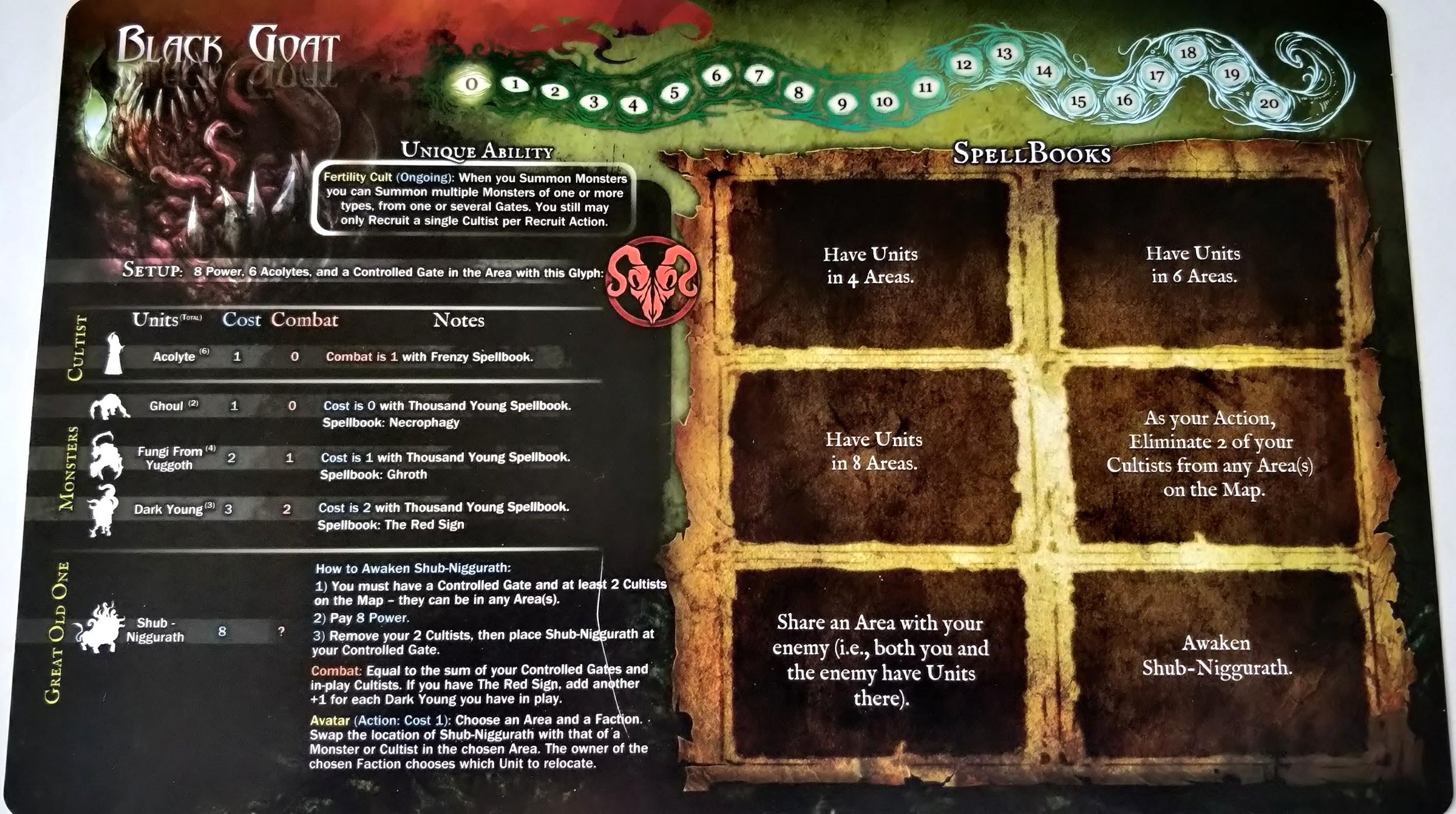
Cthulhu Wars: Duel is an asymmetric, area control game, from Petersen Games, for two players which takes about half an hour. It’s a game that wants you to know that while it does attempt to be an affordable, streamlined version of the half ton of glorious coloured plastic that was Cthulhu Wars, there will be expansions. Rather than explain the game you’ve purchased Duel’s manual is a cosmic nightmare of clarifications, citations and explanations for Great Old Ones who aren’t even out yet.

Why bother just letting you know about the game in front of you and moving on when you can drive your players to their own special Lovecraftian loss of reality. Why put in an example of a rule that is always true if this box is all you own, when you could throw in a paragraph about how this other Old One (you don’t know them, they don’t go to school here. They’re from… er… Canada, but don’t, like, check or anything because they’re shy… probably) can totally do things differently.

When I looked on YouTube for information on how to play, most of what I found was people telling me what the game isn’t. It’s not Cthulhu Wars. People seem to love telling you how it’s similar to or different from the beast that spawned it, but don’t seem to care if you’re coming in fresh (because CW is a ridiculously decadent plastic fest (as many good Kickstarter games are) and you can’t afford it or justify the shelf space).

I spent 2 hours reading the manual and it’s full of unnecessary bullshit that caused me to really struggle with what is actually a very simple game. So simple in fact that I would recommend you start with the reference sheet on the back of the manual as well as your player mat, and only use the manual itself for clarifications and picture examples of what things are called.

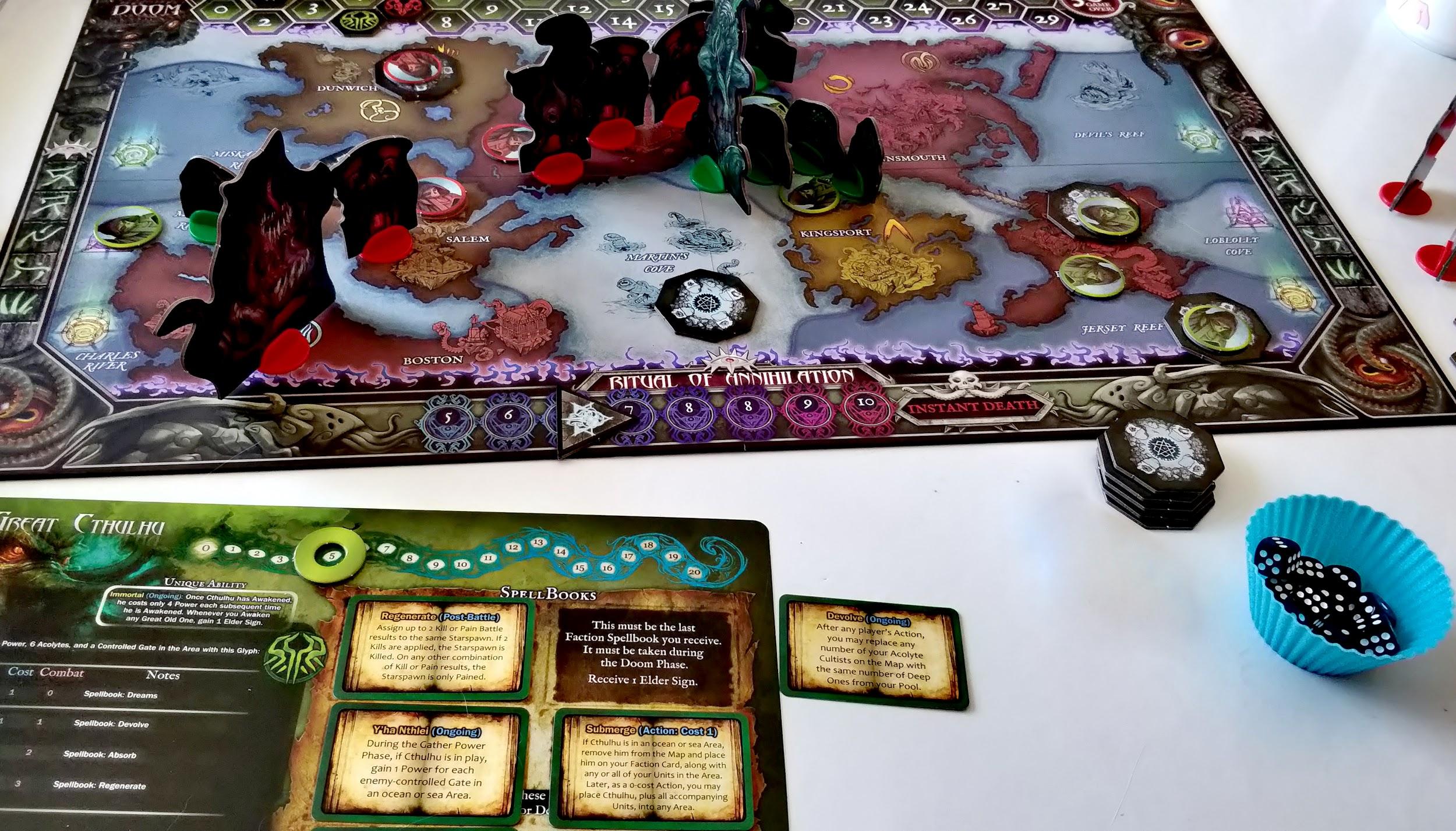
CW:D takes place in four phases and as many rounds as necessary (4-5 seems to be the average). First up the Action Phase: if you’ve got power, spend it to move, fight, open gates, deploy or capture cultists. Then comes the Gather Power Phase where you’re awarded power based on how many cultists you have on the board, any opposing cultists you’ve captured, how many gates you control, and any gates that are currently abandoned on the board. Next you decide who the first player is, based on who has the most power now. And finally it’s the Doom Phase where you can perform a ritual for some power to generate more Doom and a token with a secret amount of Doom.

The winner is whoever has the highest Doom score and the game end is triggered either when someone goes over 30 Doom or when so many rituals have been completed that you move to Instant Death.

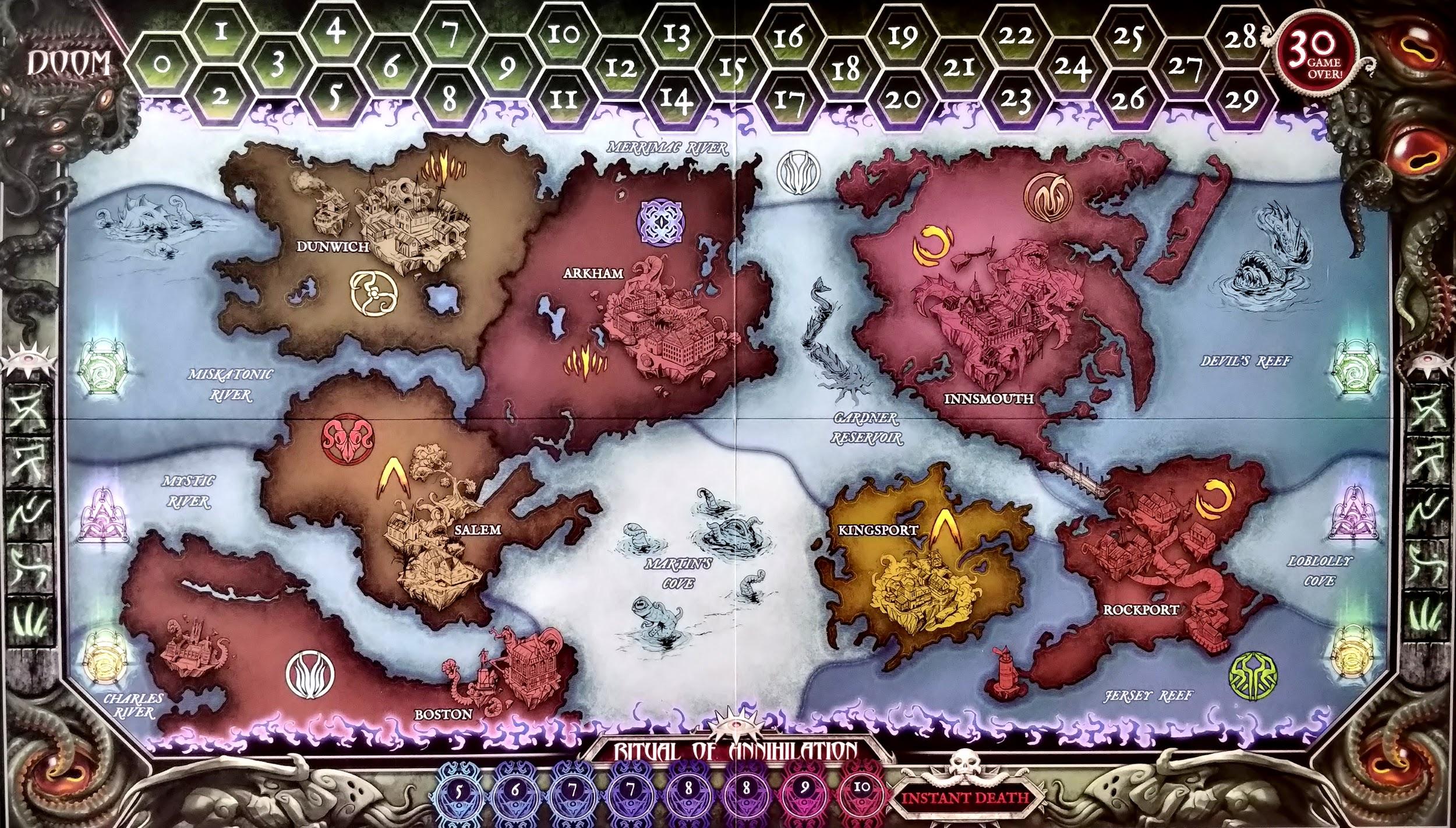
That’s it, two short paragraphs and you’ve got the gist of the game. What else is there? Well, there’s player mats, spell books, cardboard standees of your various horrors plus discs to represent your cultists, and a map board to shuffle your units around on.

When you realise that the world wraps around horizontally (like Asteroids), you’ll understand how little space there actually is to claim, but claim it you must if you’re to gain the power you need to bring about your preferred version of the end of the world.

On your player board you’ll see a clear explanation of your various units, including summoning costs, attack power (number of dice to roll for them) and any special abilities. On the right side of the board are 6 slots with various conditions that must be met. Once you meet one of these you can select one of your spell books to activate into that slot, to give you an advantage for the rest of the game. The order you choose them is entirely up to you and gives you some nice strategizing to do as the game goes on.

One nice rubber-banding technique is that if you run out of power before your opponent, you can push up the decay counter by one space. This means that they’ll have to pay whatever the current decay cost is before taking any further actions, which is a great way of stopping one player absolutely running away with things early on.

Apart from the abysmal manual, the other massive downfall of this game is its combat. Combat power is based on the type and number of each unit you have on the battlefield. Different units have higher combat scores, meaning you can roll more dice. There’s no rerolls, nothing that can mitigate a bad roll, you just get your number, roll that many dice, and work out if you’ve actually done anything to your opponent. A six is a kill, four or five is pain, everything else is worthless.

Once both players have rolled, You can assign your opponent’s damage to your units as you see fit. With kills returning units to your pool (to summon again) and pain causing units to flee to a safe, adjacent space, but leaving them alive. While it’s simple and clean, it’s a type of randomness I detest in area control and war games because a few bad rolls will absolutely ruin you.

While I had an okay time with Cthulhu Wars: Duel, I felt it could have done with a more concise rulebook, and some way to mitigate the randomness of dice rolling. Whatever else it is, it’s short, so ultimately not very offensive (apart from how it’s based on Lovecraft and no matter how the current fan community tries to pronounce certain words these days, they were intended to be racist as heck, so there’s that.

Pros:

  • Affordable
  • Decay mechanic helps keep players score closer together.
  • Minimal plastic components

Cons:

  • Poorly written manual
  • Basic dice rolling
  • Lacks depth

Final Score: 6/10

Just Call Me Garfield – Bargain Quest

It’s not even noon when I look up at the sound of some young and too-eager stranger smearing their face and fingers over my shop window. They will pay for those greasy streaks, let there be no doubt. That holy sword has suckered in more experienced “heroes” than this.

As they step inside I plaster on my expert customer service smile and prepare to shake them down. “Good day to you friend. What brings you to my humble shop on this gobin-ravaged morning?”

“I seek arms that I might wipe the ignoble dark-dwellers from this fair village. Pray tell me good shopkeep, how much for the holy blade displayed inst thine window?” they reply.

Of course they’re a cleric, the pretentious tone always gives it away. Well, that and the overly ornate book of vague bigotry they can’t seem to put down.

“Oh, it’s a beautiful item, laid in my care by Sister Illumination Piety. Alas, it is not for sale.”

“Blast!… I mean, alas. Then have you ought else I might use in my noble quest to defeat the goblin chief and free this village from oppression?”

I look them up and down, using my finely honed eye for the weight of a purse and estimate they’ve got, at most, 15 gold.

“Fear not, noble warrior, let me show you this fine holy symbol, set here by Sister Peitiy’s (less well-funded) forbear, Sibling Luna.” I hand them the necklace I’d picked up as a free gift with my last bulk weapons order.

“Truely, I feel the presence of our divine Mistress emanating most powerfully from this item. I must have it.” They’re almost salivating, it’s kind of weird.

“I’m afraid the price is quite high, due to it’s noble provenance.” I reply, glancing down as I fear that if they catch my eye I’ll just piss myself laughing. Hold it together. “Tis 15 gold. Alas, I could not part with it for less.”

“Be silent then, and takest mine coins, for though it is all my worldly wealth, it is vital in my quest to eradicate evil.”

“Wouldst your holiness care for a bag?” I respond, pocketing the gold, faster than you could blink.

“Nay, I shall wear it now, and always.” they reply, striding out out the door, glowing with pomposity.

Bargain Quest is a 2-6 player card-drafting game of capitalism in a fantasy village by Jonathan Ying. It plays in about 45 minutes and has some delightful artwork. Players take an individual shop board, which comes folded in half and showing what the shop front would look like. Upon opening it up you will find your display area, places to put any upgrades and employees as well as a reference chart showing the round order.

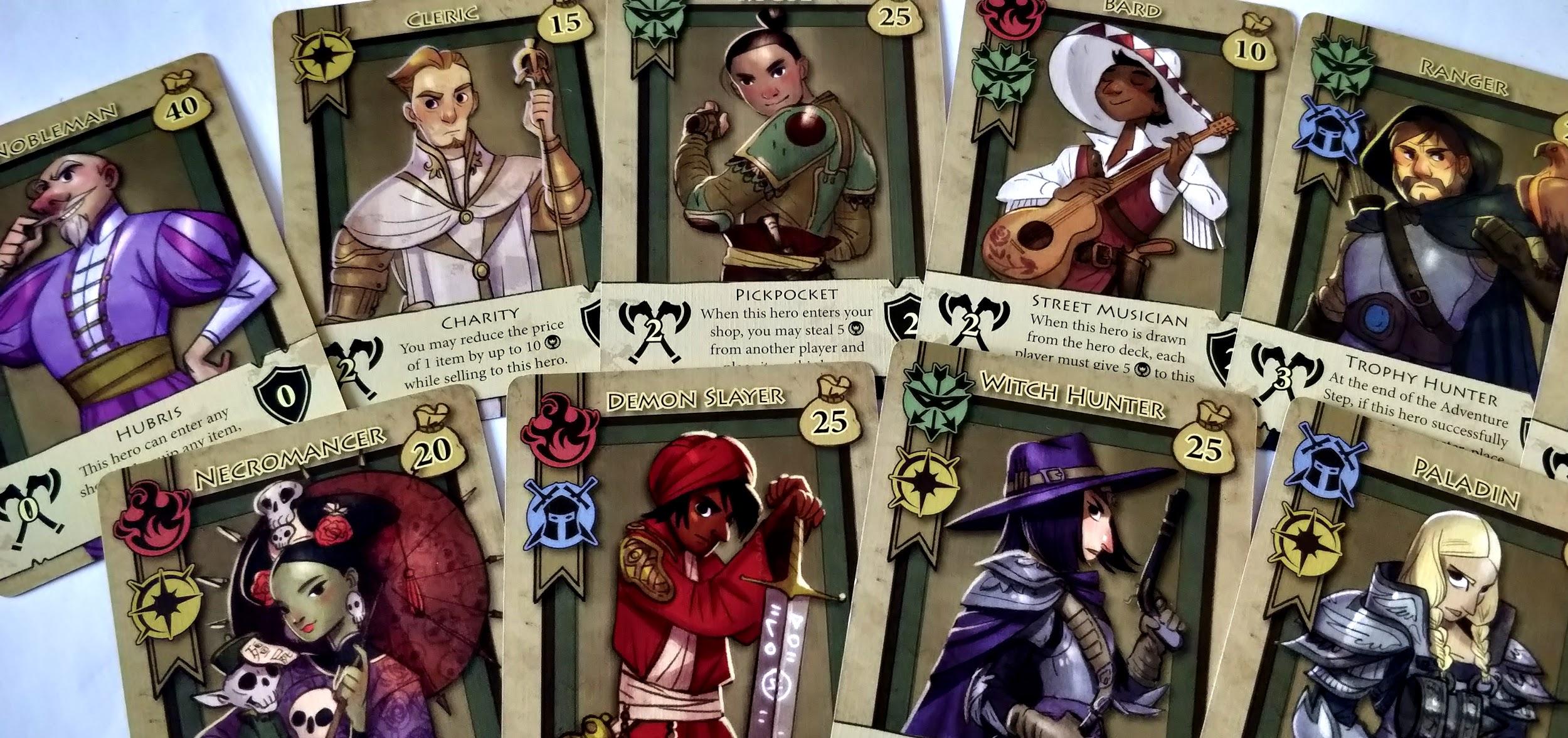
During setup players will lay out a stack of three monster cards (escalating in difficulty) as well as a number of hero cards equal to the number of players. Each hero card shows their class and abilities, but more importantly, how much money they have to spend in your shop.

Starting with the supply round, players reveal the next monster plaguing the village and are dealt 4 item cards face down. They then take one item and pass their hand to the next player until everyone has drawn their 4 items.

Next comes the display phase where players take an item and which they hope will entice a hero in. The item with the most hearts displayed on it will get first dibs on which hero will shop with them. However, this item cannot be sold so you’ll need to make sure you have something you can actually sell these adventurers when they are drawn in. Furthermore, the items will have symbols which denote the class they are appropriate for. Both items and heroes may have multiple symbols and those with more symbols will usually have more money to spend.

Are your items good enough to guarantee that paladin popping in? Or do you hedge your bets and ensure you have enough choice if you end up with the fighter?

Once everyone has selected a display item these are flipped over and the shopping phase begins. Based on who’s display had the most hearts players take in an appropriate hero. If none are left, players may take whoever’s left over (if you’ll excuse me a moment, I need to go and cry out some childhood memories of the picking of sports teams).

With shoppers brought in, it’s time to relieve them of their funds in exchange for any appropriate goods. The thing to consider here is if you can outfit them sufficiently to take on the current monster. Even if they don’t defeat it, they may come back with additional funds for you to help them dispose of.

At last it’s on to adventure. It brings a tear to the eye, seeing a young wannabe hero heading off to fight evil, carrying a sword you’ve covered in your shop’s branding. This wouldn’t be a tabletop fantasy game without a little randomization though, so heroes receive a card from the adventure deck. This could be a bonus to attack or defence, or even some extra gold they found on the way to the dungeon. Alternatively, it could be a spot of bad luck that gives them a debuff for the run.

Each player now takes a turn to strike down the terrors of the dark. The monster cards show special actions such as stealing gold from heroes before the shopping phase, or robbing a players store at the end of the round. They also include their strength and toughness. Hit them hard enough to score a hit and that’s a point for the player that kitted them out. However, if they’re not armoured sufficiently, they’ll be returning to town in a body bag (well, probably a hempen sack, if they’re lucky).

If, after all players’ heroes have taken a swing at the enemy, there are an equal number of hits to players, then that enemy is defeated and surviving adventurers will receive a handsome reward. If the enemy still lives, they get a smaller reward and a bonus point for their player. After which, they return to town, tossing their old equipment in a ditch on the way. Because those items are just “sooooo last encounter”.

Expired heroes are replaced with a new one drawn from the deck and returning heroes will have to make the most of the money they have.

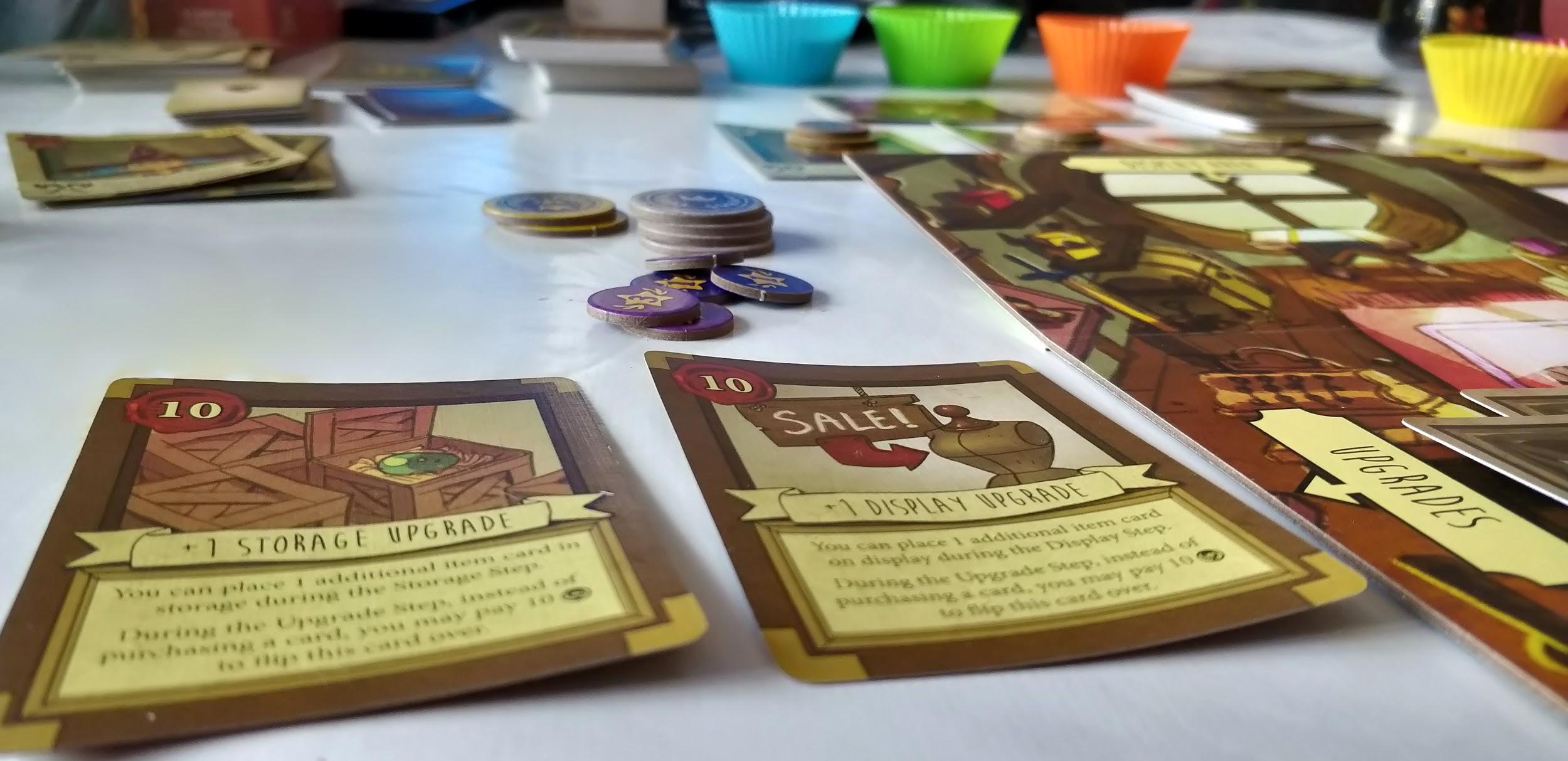
As day draws to an end, it’s time to look at upgrading your store. Purchase extra display space, extra storage or even workers to help out around the place.

Last thing before bed, you may pack away an unsold item into storage. This could be something from your window (keep it aspirational for that paladin, eh?) or something from your hand.

And so it goes, day in day out, until the final monster is defeated and the village is free. Woo! The winner is the player with the most points (with bonuses for extra gold in your till).

There’s 4 different monsters of each of the three levels so there’s plenty of opportunity for replayability there. Additionally there’s a huge item deck to work through as well as a good number of heroes to send on their adventures. The art is charming and the components look lovely. That said, during my first play session, I noticed that all the cards were starting to curl. It’s not particularly humid or damp here so I’m at a loss as to why they were curling like foil valiant Magic: The Gathering cards within an hour or so.

Pros:

  • Beautiful art
  • Fun gameplay
  • Lots of variety in the items

Cons:

  • Cards quickly started curling once opened for the first time
  • Can feel a little too random with small player counts
  • Capitalism

Final Score: 7/10

Snug As A Bug – Patchwork

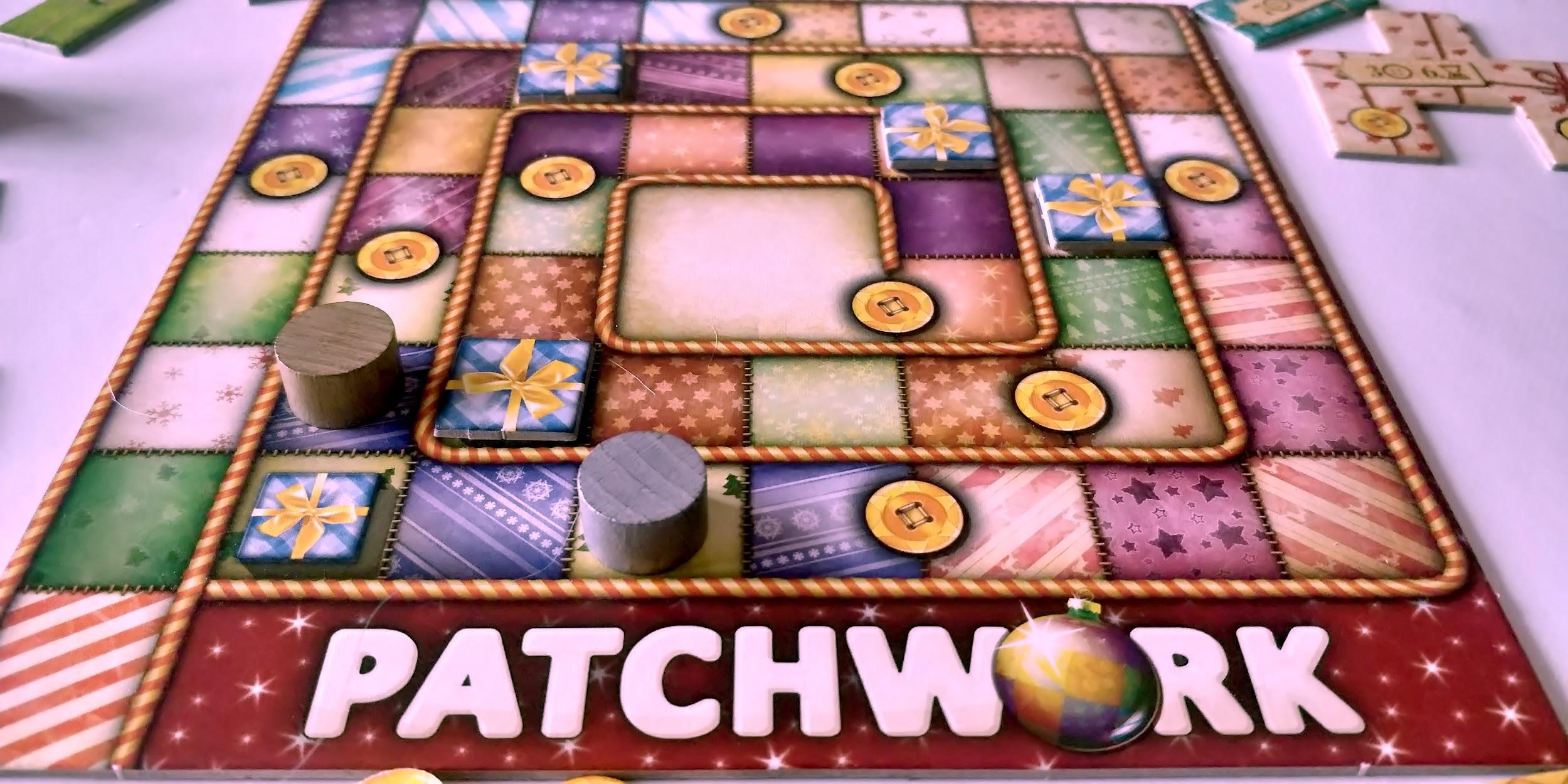
Quick note: I’m reviewing the Chr***mas edition of Patchwork, because that’s what came in my Zatu new release box at the end of November. However, I have a lot of trauma around the holiday so I’m just going to call it Patchwork for 99% of this review.

Patchwork is a charming little puzzle game by Uwe Rosenberg for 2 players and takes about 30 minutes to play. Like a lot of Rosenberg’s games, there’s plenty of poliminos to place (I won’t kinkshame, I love a bit of Tetris myself).

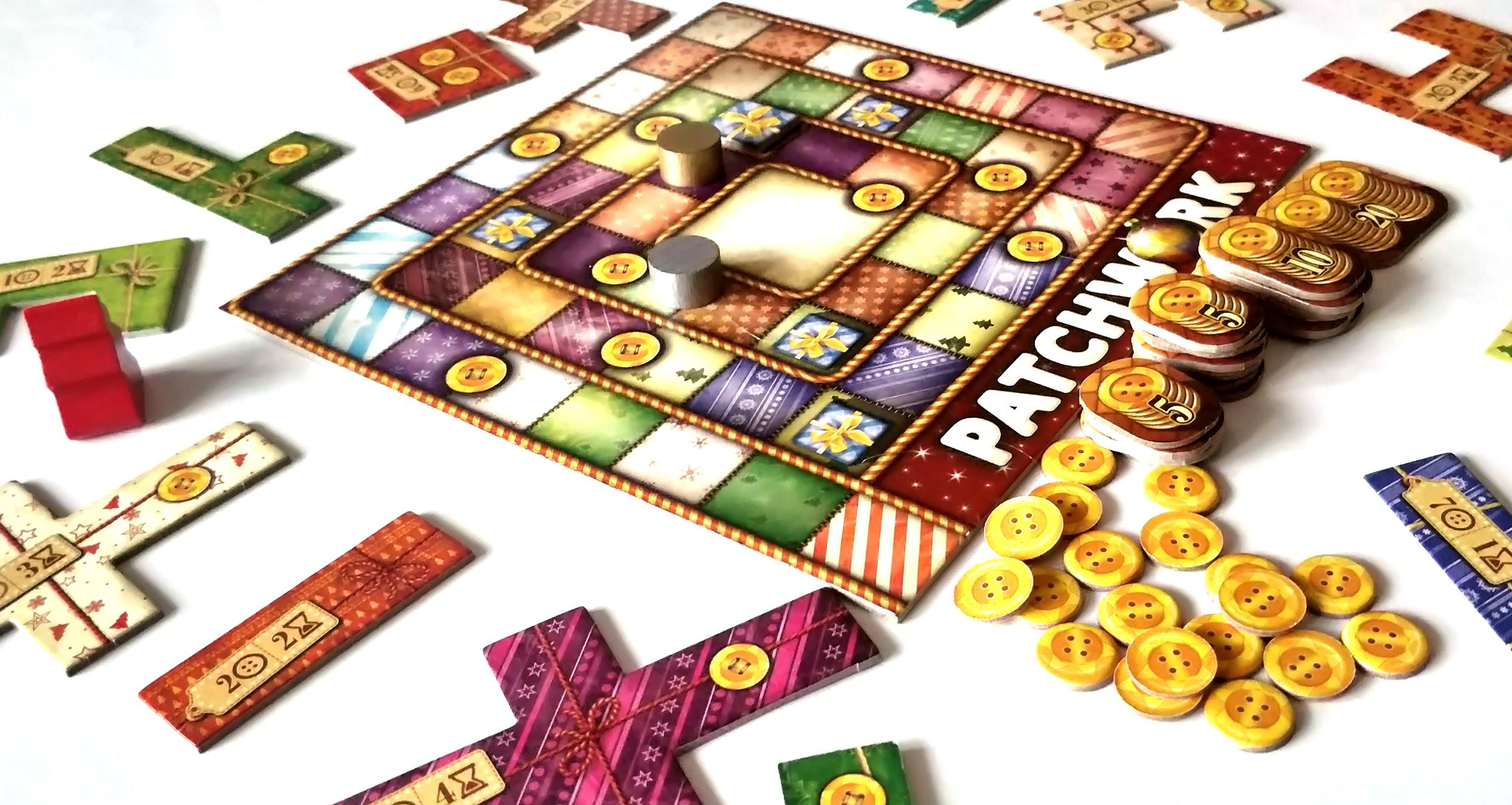
Each player takes a 9×9 quilt board, a matching player token, and five buttons as their starter funds. The spiralling time board is placed in the centre of the table and the polimino patch tiles are randomly placed around it in a circle. Next players locate the 2×1 tile and place the marker token ahead of this in a clockwise order.

The first player will pick one of the three patches ahead of the marker to take. They then move the marker to that position and pay for the tile, which has a cost in time and buttons. Buttons are paid straight to the bank and time is paid by moving along the time track, the number of spots shown on the tile. The player who is furthest back along the track will always be next to select a patch to sew.

This leapfrog method really helps to balance out play. If someone gets in a lucky position and gets a high value patch, they may find themselves waiting to move ahead while their opponent gathers up smaller tiles needed to fill in awkward gaps. It forces you to look ahead at the rest of the board, as well as considering the three tiles you can choose on your current turn. Set up just right and you could position yourself ideally for several turns.

Patches come in various sizes and shapes and some will show one or more shiny gold buttons. The time board also shows buttons at various points along the route and passing these will allow you to score based on the number of gold buttons shown on patches you’ve already sewn to your quilt.

Alternately, on your turn you can move to the position directly ahead of your opponent on the time board. In this way, you earn a number of buttons based on how many places you travelled. As such, you never have to worry about running out of funds to buy more patches. However, that time is always ticking down and empty spaces on your board will cost you two points each at the end.

Speaking of which, the game ends when one player makes it to the centre of the time board. Final scores are based on the number of buttons you have earned minus any deductions for uncovered areas of your quilt. There’s also a bonus of seven buttons for the first player to fill a 7×7 area on their quilt.

While Patchwork could seem like a simple game for kids that you could easily dismiss, it has the potential to be not only a spacial awareness puzzle, but a mind game with your opponent about when to move forward, when to take a tile based on how long it will take you to sew, and when to just dive in and grab a patch that will give you a regular income of those shiny gold buttons.

The tiles and boards are a lovely thick cardboard, the tokens are all wood, the box isn’t excessively large, it’s a lot of fun, easy to teach, easy to set up and tear down. I have really enjoyed my time playing this game and look forward to getting the review photos out of the way so I can just change the box to say it’s the Unicorn Dance Party Edition (it’s a far superior winter festival. Don’t @ me).

Okay, time to grit my teeth and just get on with mentioning the differences between this and the standard version of Patchwork.

This festive edition features gold buttons instead of blue, the colours are a bit more vibrant, the patches look more like wrapped gifts tied with string (to heck with trying to wrap most of these shapes!), the marker token is a red pine tree shape and the other tokens are gold and silver… oh, and it comes with a T shape cookie cutter (for some reason. Maybe gingerbread. Sure, let’s say gingerbread).

Pros:

  • Fun.
  • A little deeper than it looks.
  • Vibrant colours.

Cons:

  • It’s got the word Chr***mas in the title.

Final Score: 8/10